

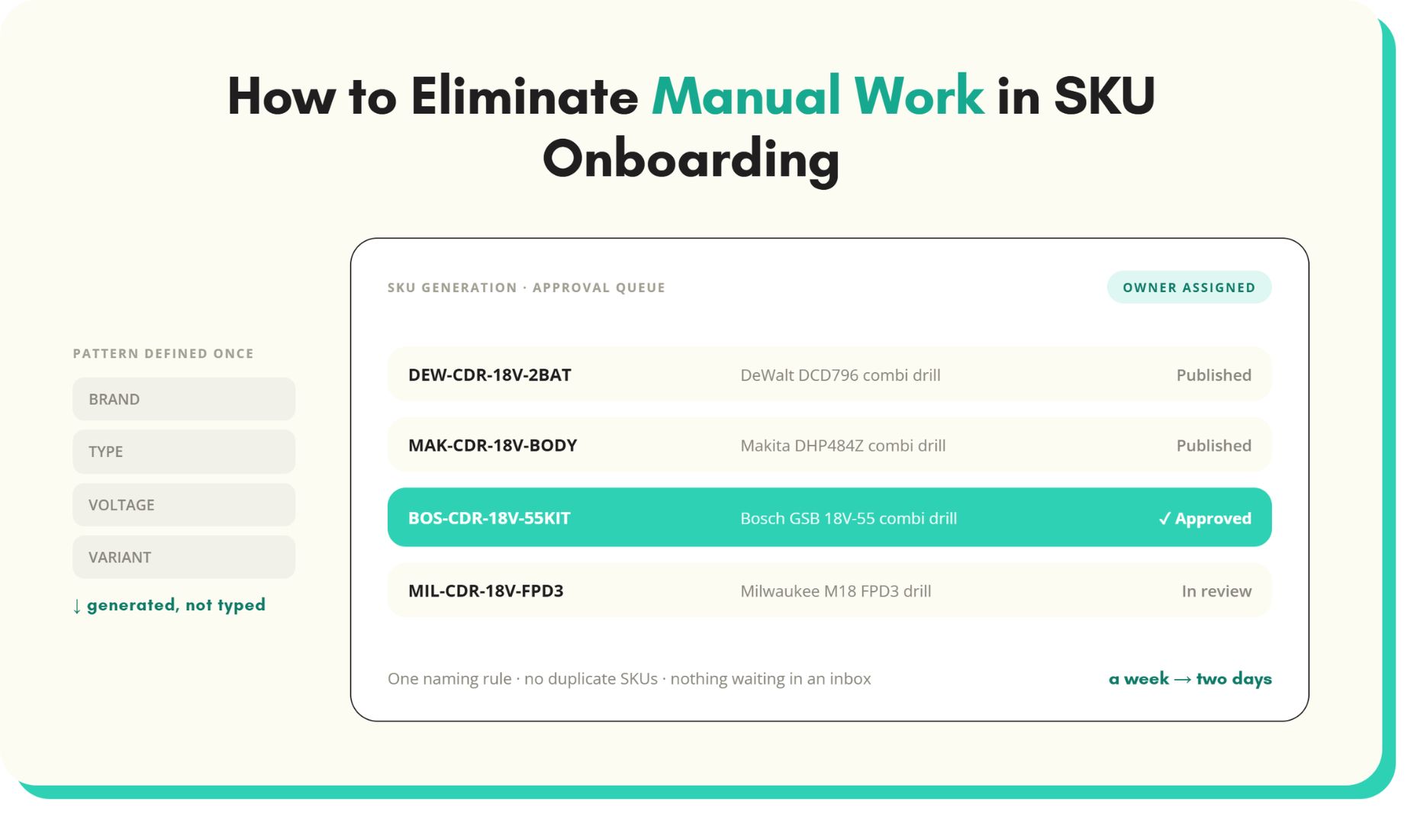
Supplier data arriving as PDFs, spreadsheets, and emails in no consistent format is the starting point of most of the pain.
Manual SKU onboarding breaks down for a predictable set of reasons. Supplier data arrives in inconsistent formats, different channels each expect their own shape of data, and image handling, spec extraction, and SKU creation all sit as separate manual tasks nobody has connected into one process. To eliminate manual SKU onboarding work means addressing each of these. Two areas in particular tend to get the least attention despite causing some of the most persistent friction: how SKUs actually get created, and how a listing moves through internal approval before it goes live.
Where manual SKU onboarding work actually hides
Supplier data arriving as PDFs, spreadsheets, and emails in no consistent format is the starting point of most of the pain. From there, different platforms require different shapes of the same underlying data. Image handling and spec sheet formatting sit as separate manual tasks, and SKU creation itself is often still done by hand, one product at a time, by whoever happens to be free that day. The result is a slower time-to-market, higher error rates, and a team spending its time on repetitive formatting rather than anything that requires actual judgement. That tends to be exactly the kind of work that burns out otherwise capable people faster than any other part of the job.
Several of these problems are covered in detail elsewhere: automating supplier data collection through a supplier onboarding platform, cleansing and standardising data are covered in the guide on how AI cleans and enriches product data, and image and spec sheet handling has its own dedicated guide. Publishing the same catalogue across multiple channels is covered in the guide on how to sync product data across sales channels. This piece focuses on the two pieces of manual SKU onboarding those guides do not cover: generating the SKUs themselves, and moving a listing through approval without it stalling in an undefined queue.
Auto-generating SKUs to eliminate manual SKU onboarding steps
Manually assigning a SKU to every product variant does not scale, and it introduces exactly the kind of inconsistency automation is meant to prevent elsewhere in the process. A logic-based system defines a SKU structure once, brand, product type, colour, and size combined in a consistent pattern, for instance, and generates a unique, readable identifier automatically for every variant that matches it, rather than leaving that decision to whoever happens to be onboarding the product that day.
This removes two specific problems at once. Duplication becomes far less likely, since a rule-based system checks new SKUs against the pattern rather than relying on a person remembering what has already been assigned across a catalogue that might run into the tens of thousands. Inconsistency in naming disappears too, since every SKU follows the same defined structure regardless of which team member or which supplier drop the product came from. A catalogue with SKUs generated this way is also easier to search, filter, and report on internally, since the SKU itself encodes structured information rather than being an arbitrary string a person invented on the spot, which matters considerably more once a business needs to run analysis across product type or category and the SKU pattern itself becomes a usable data field rather than just a label.
Workflow automation to eliminate manual SKU onboarding handoffs
Manual SKU onboarding often breaks down not at the data itself but at the handoff between people. Nobody is quite sure who needs to sign off on a listing before it goes live, so a completed record sits waiting in an inbox rather than moving forward, sometimes for days, purely because ownership of the final check was never made explicit. The record itself might be perfectly ready; it is simply waiting on a decision nobody has been clearly assigned to make.
Defined, multi-step approval workflows fix this by making the process explicit rather than assumed. A specific person or role owns sign-off at each stage, a product manager approving final content, for instance, rather than an unspecified "someone" expected to notice a listing is ready. Once approved, the next step triggers automatically, whether that is publishing to a channel or handing off to a different team, rather than requiring someone to remember to progress the record manually. The result is a process with a visible status at every stage rather than one where a listing's location in the pipeline is only known by whoever last touched it, which is exactly the kind of information gap that turns a two-day approval into a two-week one without anyone actually being at fault for it.
What this looks like in practice
Consider a hypothetical mid-sized home goods retailer onboarding several hundred SKUs a week across six marketplaces. Under a manual process, several team members spend well over a week processing that volume, with pricing and attribute errors surfacing regularly under the time pressure. A supplier upload portal replaces the inbound chaos, SKUs generate automatically against a defined naming structure rather than being typed by hand, and a clear approval workflow means a completed listing moves to publishing as soon as it is signed off, rather than waiting in an unowned queue. The combined effect compresses a process that used to take well over a week into one that completes in a couple of days, without adding headcount to handle the same volume.
How to eliminate manual SKU onboarding for good
SKU generation and approval workflows are easy to overlook because neither one is the most visible part of onboarding, but both are exactly where a lot of manual process still hides even after the data itself has been automated. A catalogue with clean, enriched data still moves slowly if SKUs are typed by hand and approvals sit in nobody's queue. Addressing all the pieces together, supplier intake, data cleansing, image and spec processing, SKU generation, approval, and syndication, within one connected supplier onboarding platform is what actually removes manual work end to end, rather than automating the most visible steps while leaving the quieter bottlenecks in place.
To see how SKULaunch eliminates manual work across the full SKU onboarding process, request a demo.
See SKULaunch in action
Watch how we handle AI enrichment, supplier onboarding, and catalogue scale in a live 30-minute demo.


.avif)