

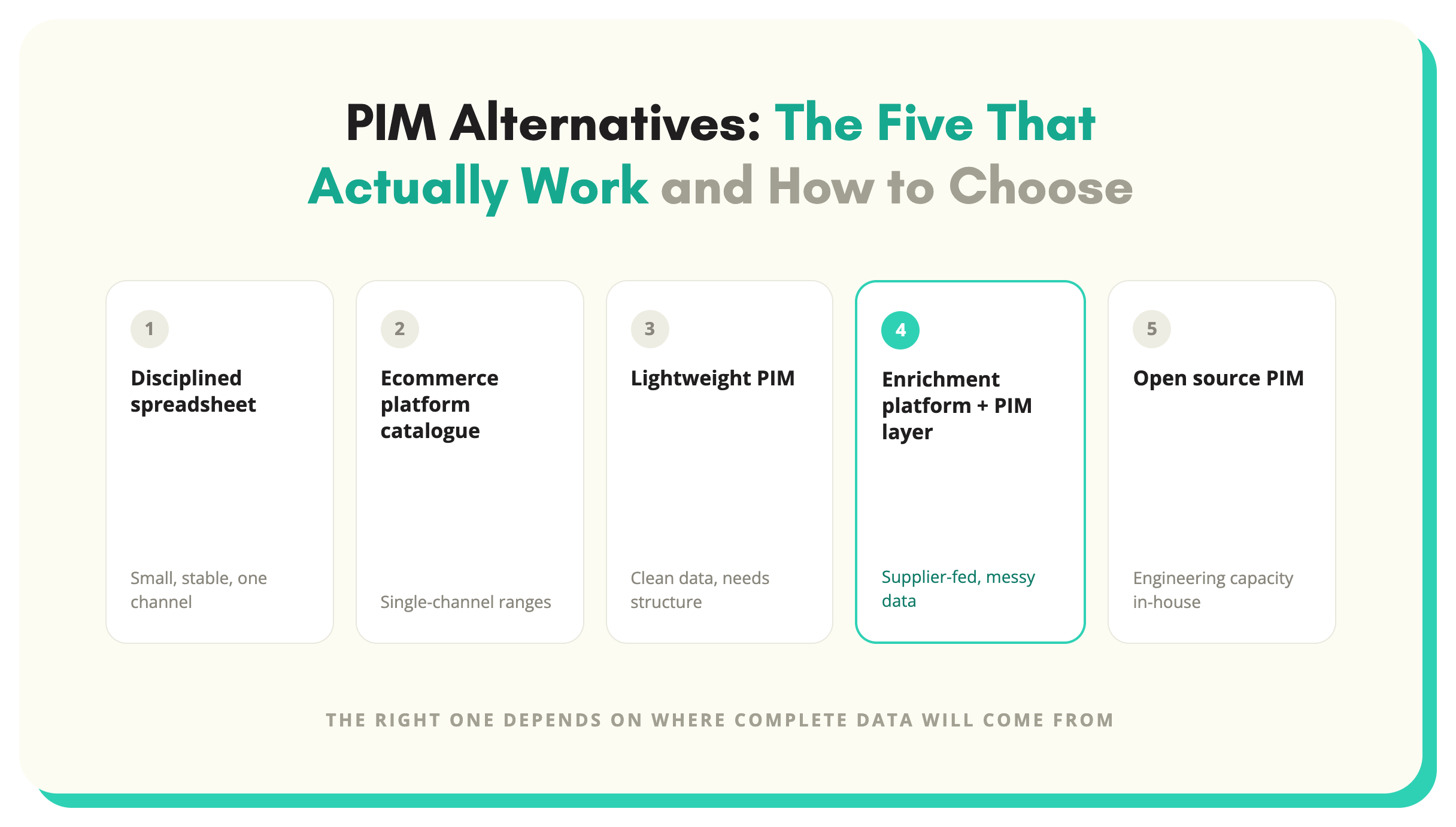
Most searches for PIM alternatives are not asking for a different PIM. They are asking whether the big system is necessary at all.
Most searches for PIM alternatives are not really asking for a different PIM. They are asking whether the six-month implementation, the integration partner and the licence fee are actually necessary to get the thing a PIM promises: one clean, complete record per product. For a lot of catalogues the honest answer is no. There are five workable PIM alternatives, and the right one depends on how many SKUs, suppliers and channels you are juggling, and on whether your product data already exists in a usable state.
Why teams look for a PIM alternative
Three reasons come up repeatedly. The first is weight: a traditional PIM is an implementation project, and smaller teams do not have a spare quarter or a budget line for a partner. The second is fit: multi-step approval workflows, print production pipelines and enterprise governance solve problems many businesses simply do not have, and paying for them anyway is how a licence fee doubles. The third is the quiet one: a PIM stores product data but does not create it, so a team whose supplier data arrives incomplete ends up with a governed, half-empty system. That distinction is unpacked in what PIM software does and does not do. The short version: storage was never the hard part.
The five PIM alternatives that actually work
1. A disciplined spreadsheet
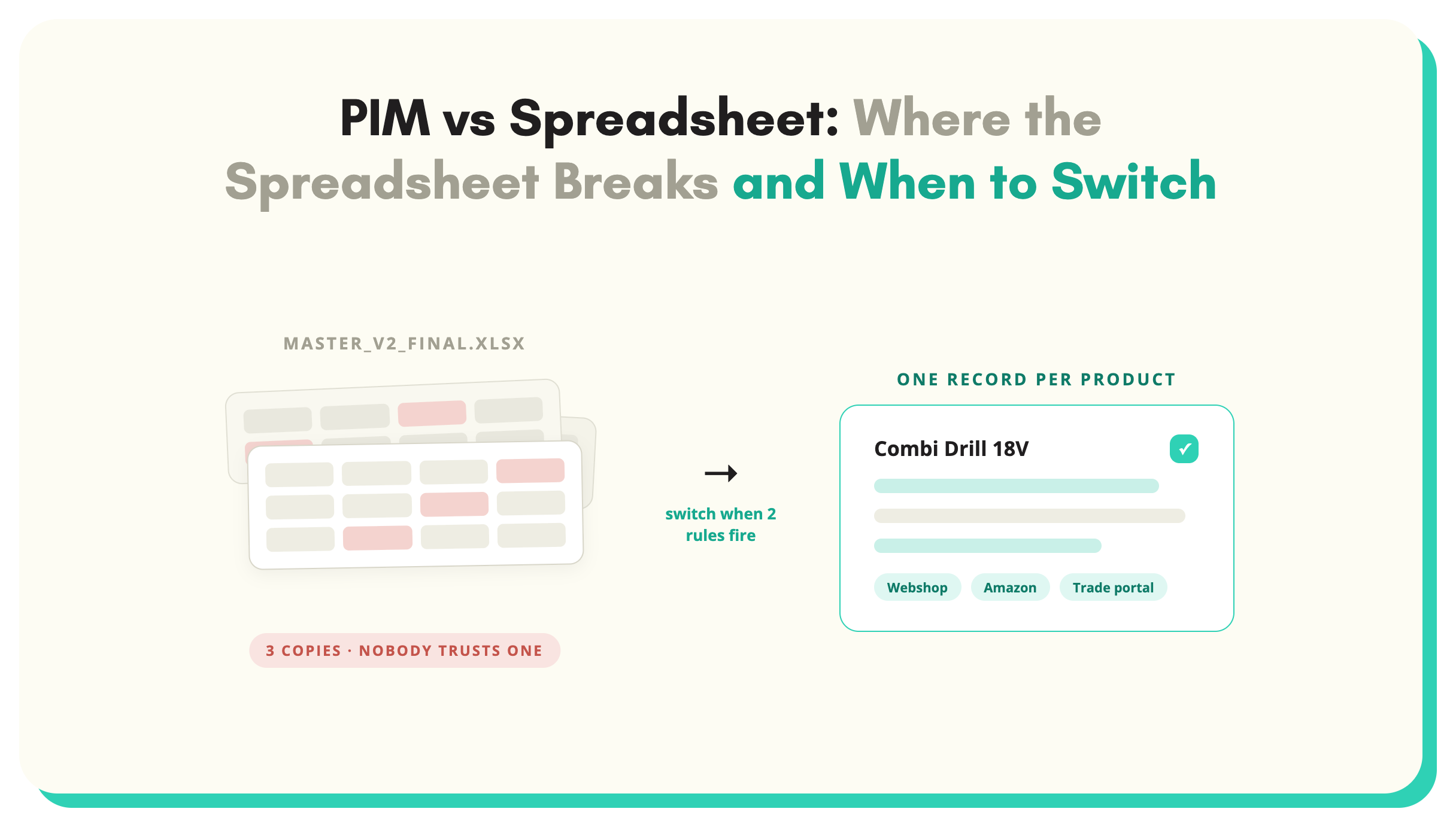
Below a few thousand SKUs with stable suppliers, a well-run spreadsheet is a legitimate system of record: one master file, one owner, defined columns per category, and a hard rule that channel exports are generated from the master rather than edited separately. It costs nothing and everyone already knows how to use it. It breaks on variants, on a second regular editor, and on the day a second sales channel needs its own version of the truth. If that day feels close, the switching rules are set out in PIM vs spreadsheet.
2. Your ecommerce platform's catalogue
Shopify, BigCommerce and Magento each carry a built-in product catalogue, and for a single-channel range it can be the only catalogue you need. Metafields and custom attributes cover a surprising amount of structure, and the data lives where it is sold. The limits arrive with the second channel, with technical categories that need thirty attributes with units, and with supplier intake: the platform catalogue has no opinion about the two hundred differently shaped files your suppliers send.
3. A lightweight PIM
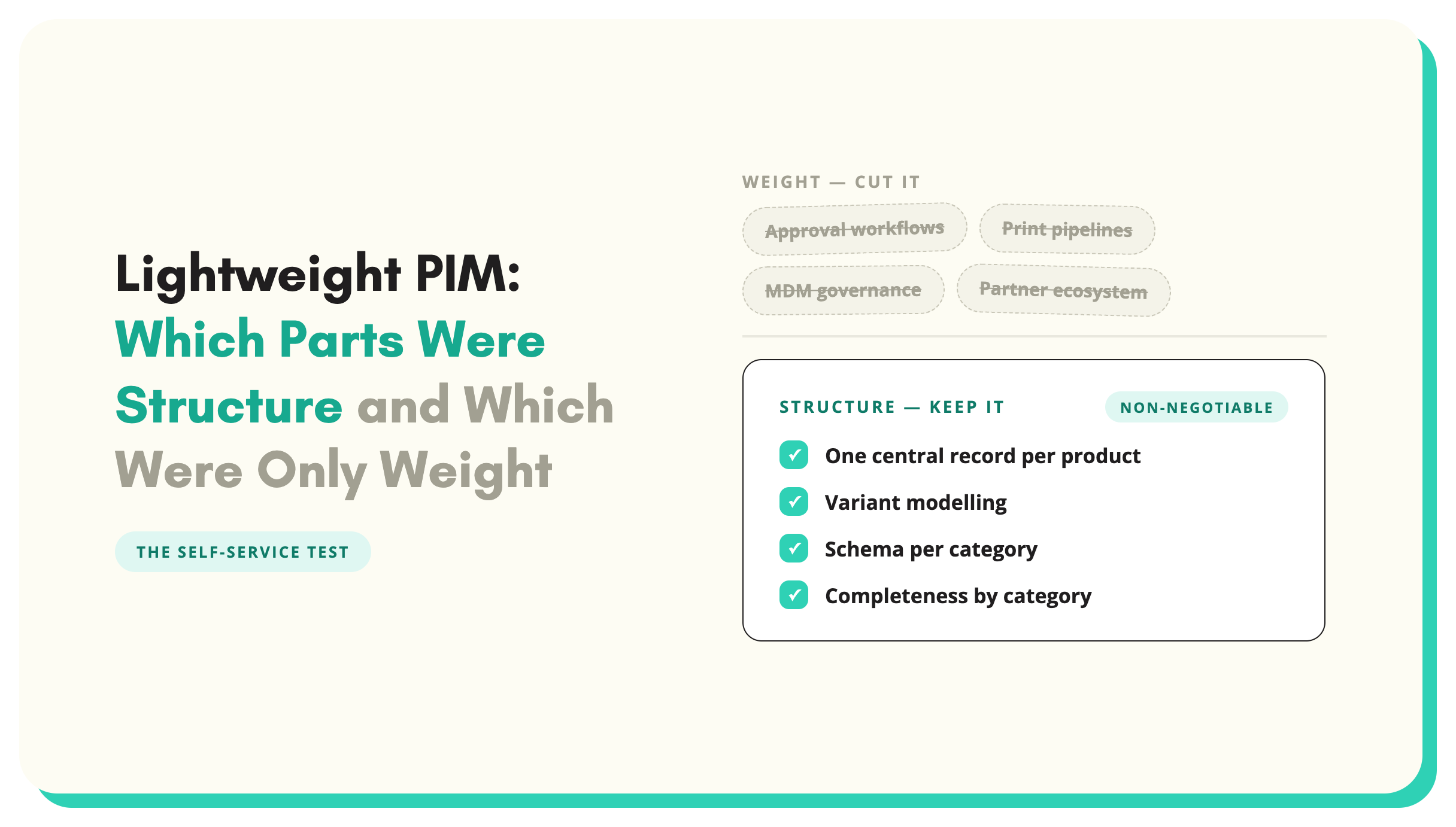
Tools such as Plytix serve teams that want proper structure without the enterprise machinery: published pricing, self-serve onboarding, built-in digital asset management, and a data model that covers most mid-sized catalogues. The trade is that a lightweight PIM still expects clean data in. It organises what you give it; it does not fix what your suppliers send. What to keep and what to drop when you go small is covered in the guide to lightweight PIM.
4. An enrichment platform with a built-in PIM layer
The newest of the PIM alternatives, and for supplier-fed catalogues the one shaped like the actual work. SKULaunch reads supplier PDFs, spreadsheets, images and URLs, extracts and normalises the attributes, then holds the finished record in its own built-in PIM layer: one governed record per SKU, variants modelled properly, AI-suggested taxonomies and attribute schemas, and pushes out to your channels. Setup is self-service and takes days rather than months. Mole Valley Farmers ran 35,000 SKUs through that pipeline in three weeks, written up in the Mole Valley Farmers case study. Best fit: retailers and distributors whose real problem is that product data arrives messy, not that clean data lacks a home.
5. An open source PIM
Akeneo Community Edition is free to licence and genuinely capable. The cost moves rather than disappears: hosting, upgrades, extensions and the developer time to run all three. For a team with engineering capacity and a preference for owning its stack, it is a serious option. For a team without one, the free licence is the cheapest part of an expensive system.
How to choose between the PIM alternatives
Match the option to the shape of the catalogue. Under a few thousand SKUs on one channel: the spreadsheet or the platform catalogue, run with discipline. A growing catalogue with reasonably clean data and a need for structure: a lightweight PIM. A supplier-fed catalogue where the data arrives incomplete, in technical categories, at volume: the enrichment platform with the built-in PIM layer, because acquiring and structuring the data is most of the job. Engineering capacity and a composable stack: open source. At distribution scale, tens of thousands of SKUs from dozens of suppliers, the acquisition problem dominates everything else, which is why product data management for distributors treats intake and enrichment as the core discipline rather than an import step.
The question that decides it
Before comparing tools, answer one question: where will complete product data come from? If the answer is "it already exists, clean, in our systems", pick the cheapest structure that holds it, which is rarely a traditional PIM. If the answer is "our suppliers, in whatever state they send it", then storage-only options, traditional PIM included, all inherit the same gap, and the alternative that creates the data as well as holding it is doing the job the others skip. Teams that answer this question honestly tend to stop shopping for a PIM and start fixing the pipeline that feeds one.
Key takeaways
- Most PIM alternative searches are really asking whether the implementation project is necessary. For many catalogues it is not.
- Five options cover the ground: a disciplined spreadsheet, the ecommerce platform's catalogue, a lightweight PIM, an enrichment platform with a built-in PIM layer, and open source.
- Storage-only options all share one gap: none of them creates complete data from messy supplier files.
- Choose by SKU count, supplier count, channel count and, above all, by where complete data will come from.
- At distribution scale the intake problem dominates, and the alternative that enriches as well as stores earns its place.
See SKULaunch in action
Watch how we handle AI enrichment, supplier onboarding, and catalogue scale in a live 30-minute demo.

.avif)