

A lightweight PIM keeps the parts teams use daily and drops the enterprise machinery. Which parts were weight, and which were structure?
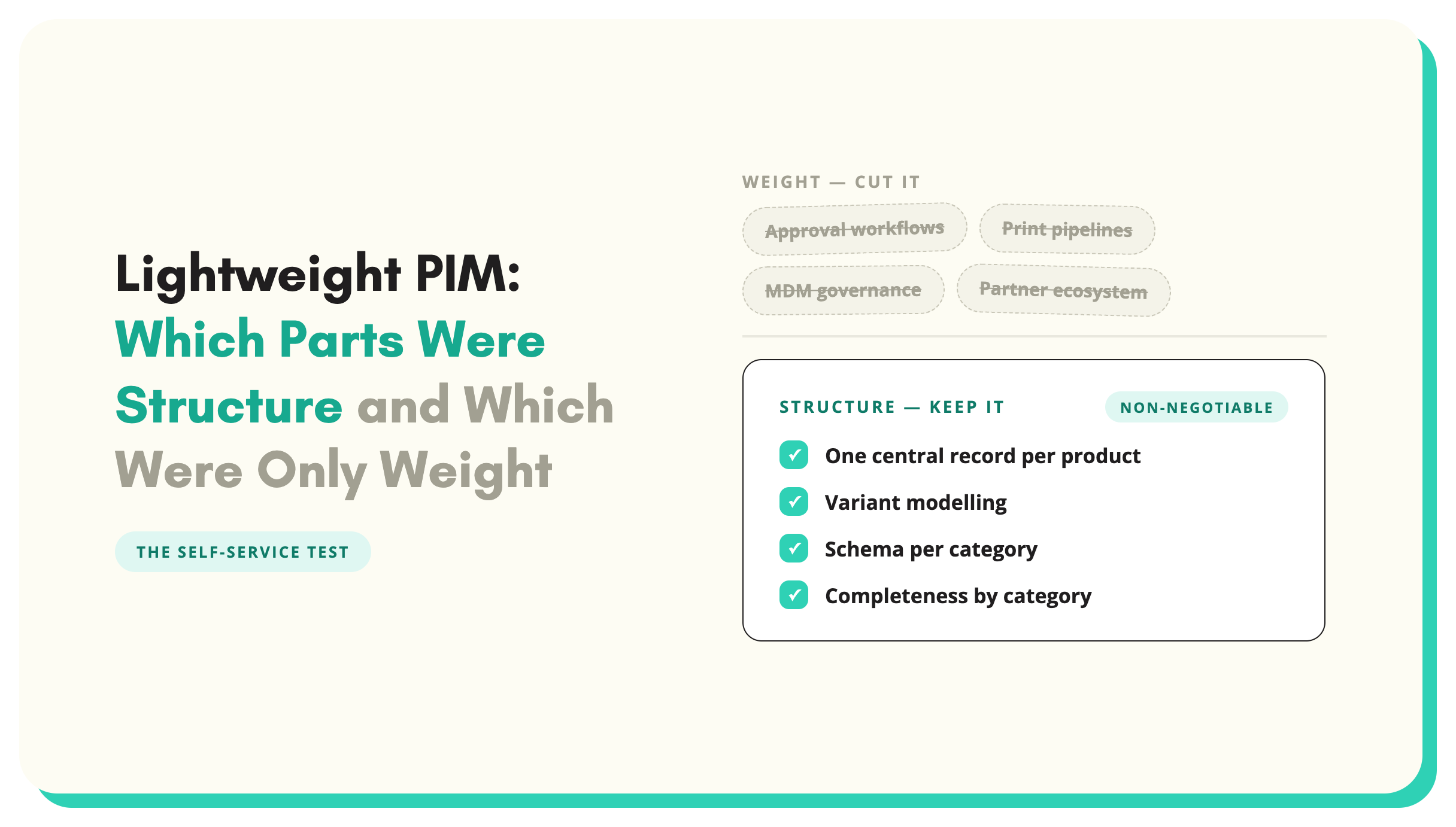
A lightweight PIM is a product information system cut down to the parts most teams use every day: one record per product, a schema that validates it, variants modelled properly, and clean outputs to the channels you sell through. What gets cut is the enterprise machinery, the multi-step approval workflows, the print production pipelines, the governance designed for forty editors across six countries. The lightweight PIM question is not whether smaller is good enough. It is which parts of the big system were weight, and which were structure.
What a lightweight PIM leaves out
Four things, usually, and most teams never miss them. Approval workflows, because when two or three people own the catalogue, a change does not need a committee. Print channel management, because the catalogue that goes to print is a different business problem from the one that goes to Shopify. Multi-domain governance, the MDM-grade machinery for reconciling product, customer and supplier masters across a dozen systems, because most mid-sized businesses have three systems, not thirty. And the partner ecosystem, because a system you can configure yourself does not need one. If you have run a catalogue for a year and never wanted any of these, they were weight.
What a lightweight PIM cannot leave out
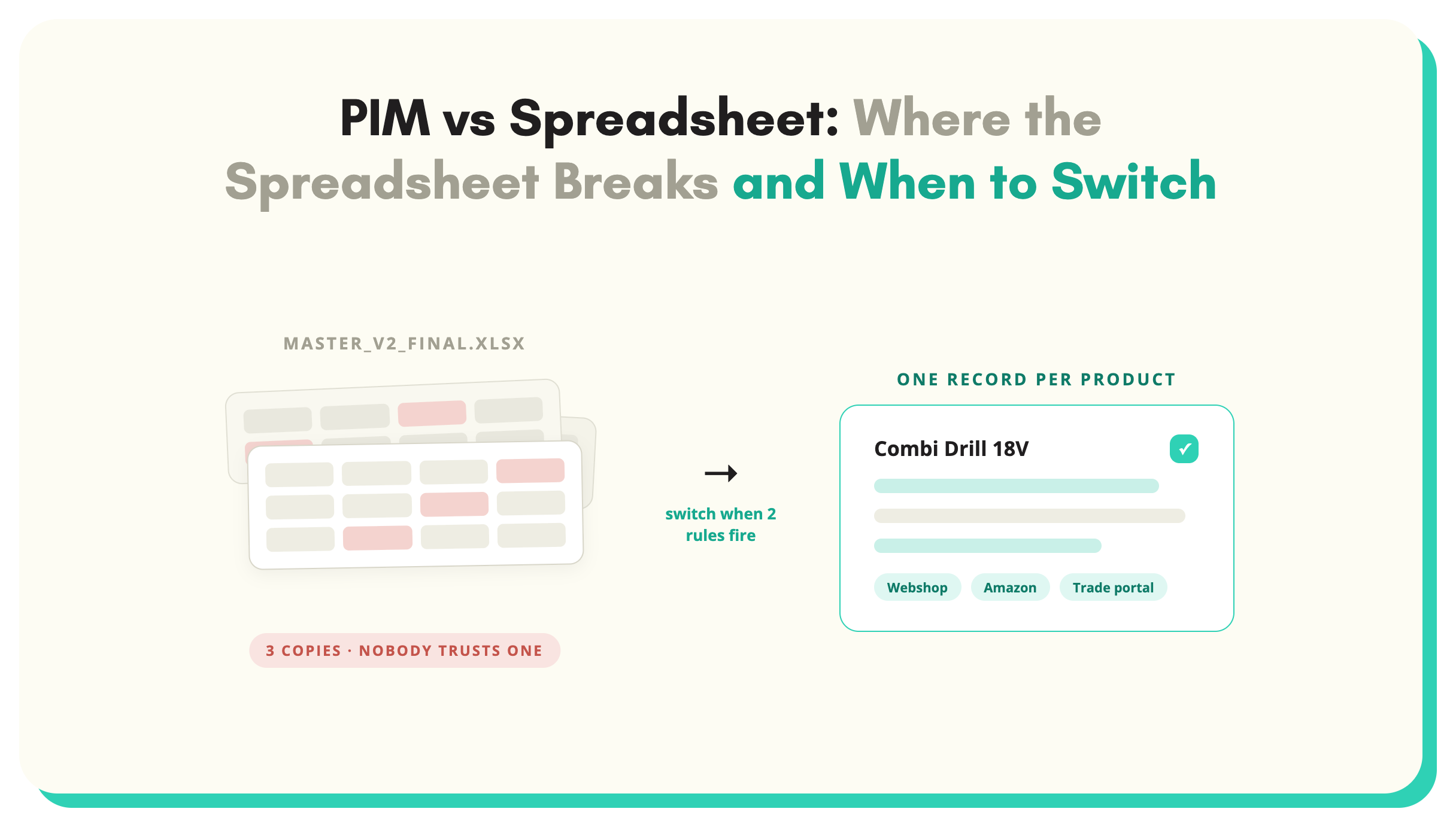
Four other things are structure, and a tool that drops them is not lightweight, it is a spreadsheet with a login screen. One central record per product, so every channel and every colleague reads from the same place. Variant modelling, so a product with twelve sizes is one parent and twelve children, not twelve repeated rows. A schema per category with types, units and accepted values, so "18V", "18 V" and "Eighteen volt" cannot coexist. And completeness measurement by category, so you know which records are fit to publish before the storefront tells you. Channel outputs generated from the record, rather than exported and hand-edited, follow from the first rule and matter as much.
The self-service test
The sharpest filter for simple PIM software is not the feature list, it is whether you can set the system up yourself. Take your worst category, import a real supplier file, model one variant family, define the schema, and publish to one channel, inside a trial, without a call. If the vendor's answer to that request is a demo booking and an implementation quote, the system is not self-service, whatever the label says. The same test settles most affordable PIM software claims too: the licence fee is rarely the real cost of a PIM. The implementation is, and a system you configure yourself in days removes the largest line from the budget.
Where the data comes from
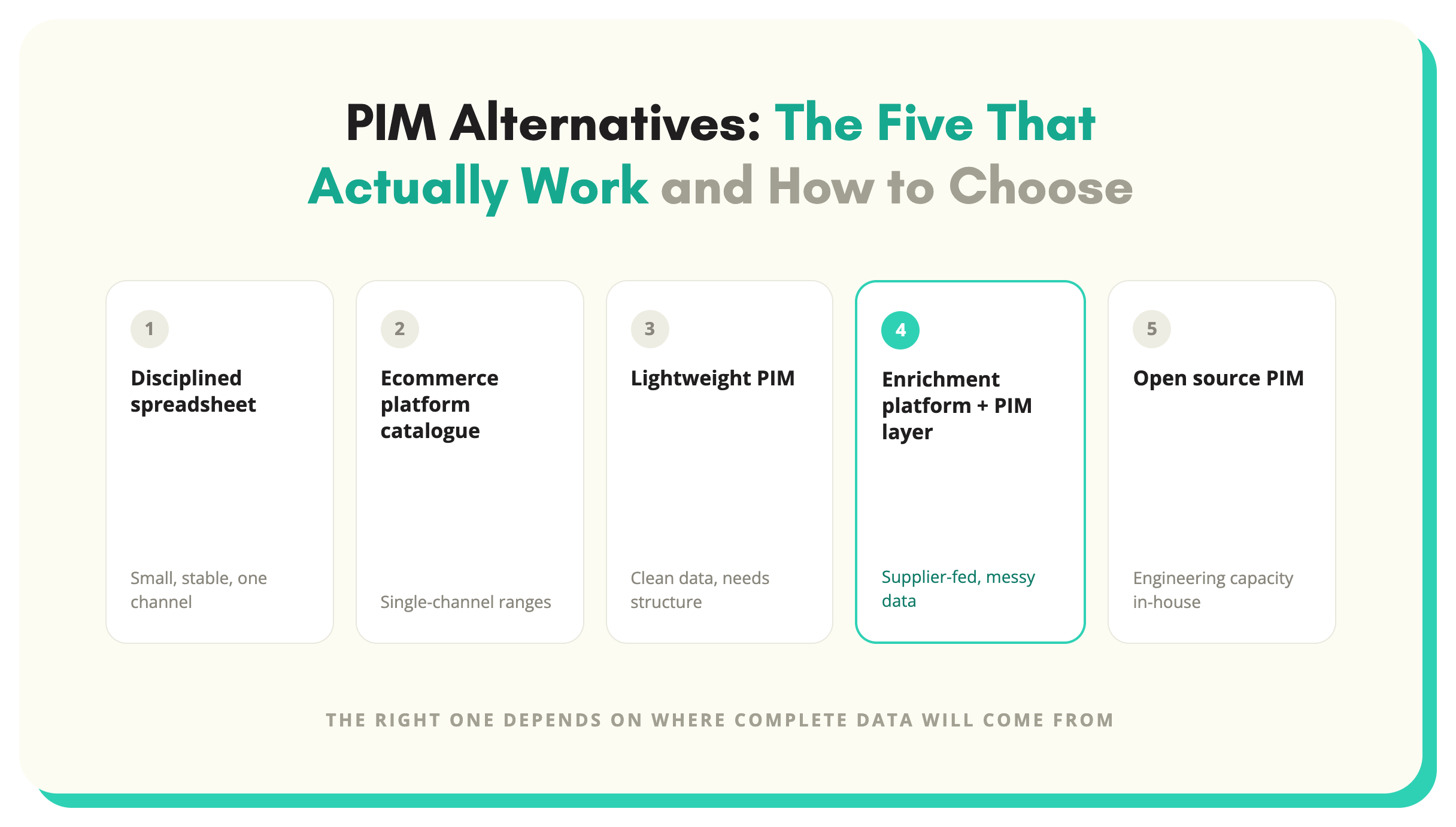
No PIM fills itself, lightweight or heavyweight. Every record in the system had to be extracted from a supplier file, normalised and classified, and for supplier-fed catalogues that work dwarfs the storage question. This is where the lightweight category splits. Tools like Plytix organise clean data extremely well and expect you to arrive with it. SKULaunch approaches it from the other end: it reads the supplier PDFs, spreadsheets and images first, extracts and normalises the attributes against your schema, and then holds the finished record in its built-in PIM layer, with AI-suggested schemas and taxonomies so the structure exists from the first import. At distribution scale, where dozens of suppliers feed the catalogue continuously, that intake work is the core of product data management for distributors, and a storage tool without it inherits a permanent manual backlog.
Choosing a lightweight PIM: a short checklist
- It imports the files your suppliers actually send, not just clean CSVs.
- Variants are modelled as parent and children, on any axis, without rebuilding the product.
- Schemas are per category, with types, units and accepted values enforced on import.
- Completeness is measured by category, not as one flattering site-wide number.
- Each channel gets its own output from one record, generated rather than maintained.
- Pricing is published, and the trial does not require a sales call.
- There is an answer to "how does messy supplier data become complete records" that is not "your team".
Key takeaways
- A lightweight PIM drops approval chains, print pipelines, MDM-grade governance and the partner ecosystem. Most teams never miss them.
- It cannot drop central records, variant modelling, schema validation or completeness measurement. Those are the structure.
- Apply the self-service test: your worst category, a real supplier file, one variant family, one channel, inside a trial, no call.
- The licence is rarely the real cost. The implementation is, and self-service removes it.
- No PIM fills itself. If supplier data arrives messy, pick the option that creates complete records as well as storing them.
See SKULaunch in action
Watch how we handle AI enrichment, supplier onboarding, and catalogue scale in a live 30-minute demo.

.avif)