

ETIM implementation fails more often from poor scoping than from technical problems.
ETIM implementation fails more often from poor scoping than from technical problems. Teams that skip the pre-work end up reclassifying the same SKUs two or three times:
- Wrong version
- Wrong scope
- No governance
This guide covers the ETIM implementation process from initial planning through ongoing maintenance, with realistic timelines by catalogue size. If you’re new to the standard itself, start with our guide to what ETIM is before coming back here.
Before you start
Three things need to be confirmed before you write a single line of classification logic.
1. Confirm which ETIM classes apply to your catalogue
ETIM covers over 7,000 product classes across electrical, HVAC, plumbing, and related technical categories. Most distributors use a subset. Pull a sample of 500 SKUs across your main product lines and cross-reference against the ETIM class library at etim-international.com. You want to know:
- How much of your catalogue maps cleanly to existing classes
- Which categories are borderline
- Whether any lines fall outside ETIM entirely
For distributors in electrical wholesale, coverage is typically high. For mixed catalogues, electrical plus PPE or safety products for instance, expect some lines that need a different taxonomy approach.
Understand the scope
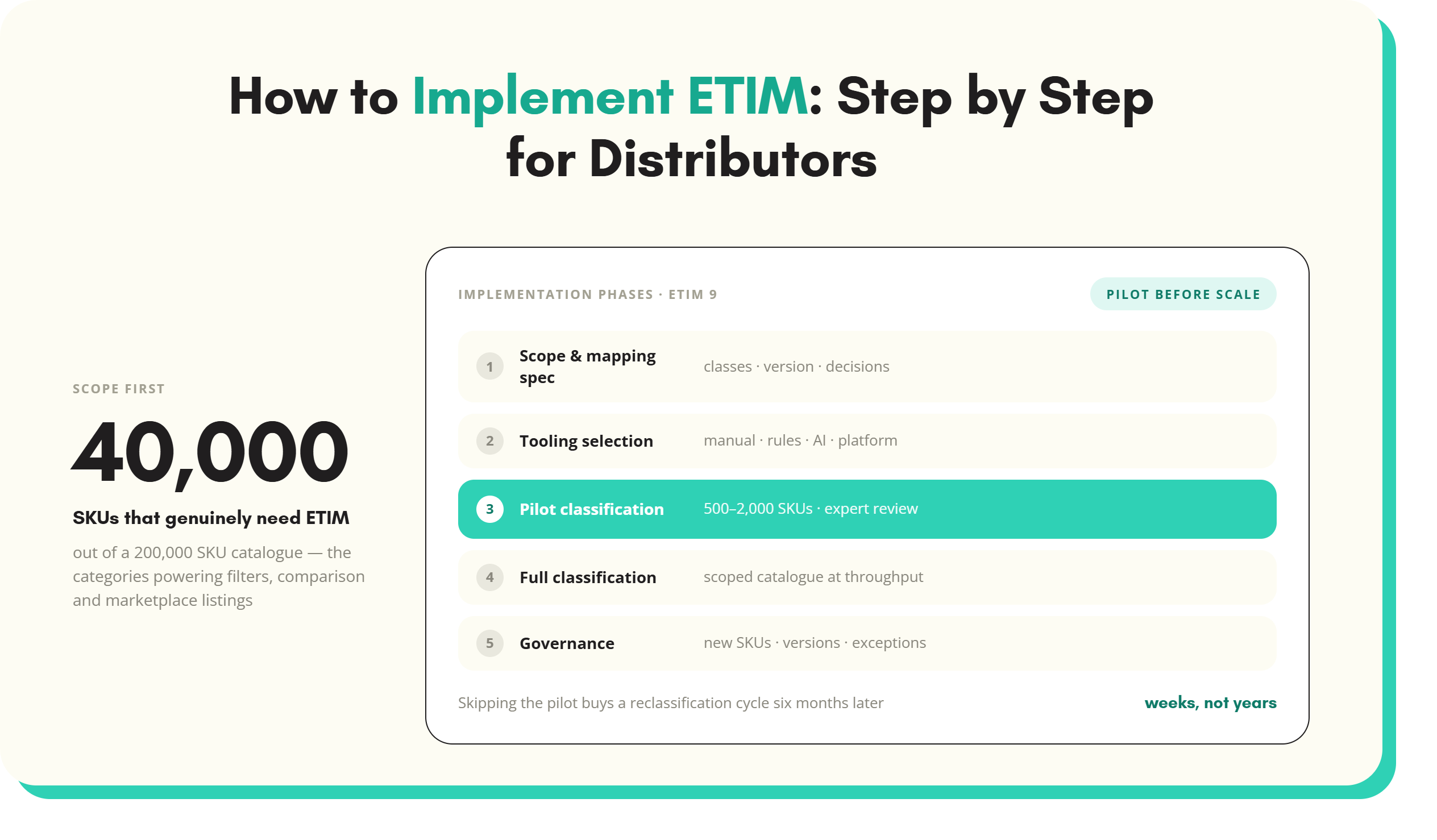
Full-catalogue ETIM classification is rarely the right starting point. Prioritise categories where structured data delivers the most commercial value: the ones powering technical filters on your website, the ones customers use to compare specifications, the ones required for marketplace listings. A 200,000 SKU catalogue might have 40,000 SKUs that genuinely need ETIM. Start there. Trying to classify everything at once stretches timelines and dilutes focus on the categories that matter most.
3. Get stakeholder alignment on the business case
ETIM implementation touches ecommerce, purchasing, product data, and often IT. The business case needs to be agreed before the project starts, not halfway through Phase 3. Apart from the end-state benefit Stakeholders need to understand:
- The scope
- The tooling cos
- The governance commitment
If you’re building the business case from scratch, the SKULaunch ETIM data mapping software guide covers the ROI argument in detail.
The implementation phases
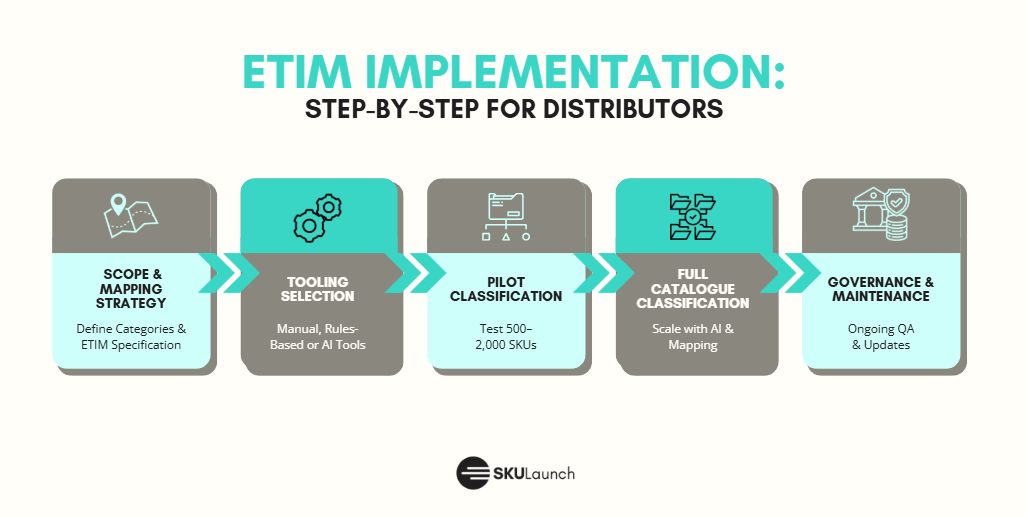
Phase 1: Scope and mapping strategy
Define the target category set, the ETIM version you’re targeting (ETIM 9 is current, see the ETIM 8 vs ETIM 9 comparison for what changed), and how classification decisions will be made and documented. Produce a mapping specification:
- Which supplier data fields map to which ETIM feature values
- What to do with missing data
- How to handle multi-variant products
This document becomes the reference for everyone involved in Phases 3 and 4. Without it, different classifiers make different calls on the same product type and you end up with inconsistent records.
Phase 2: Tooling selection
Choose your classification tooling before you run the pilot. Options range from manual spreadsheet work to AI-powered enrichment platforms. The right choice depends on catalogue size, internal resource, and accuracy requirements. See the tooling options section below for a practical breakdown.
Phase 3: Pilot classification
Pick one category, run it through the full classification process, and measure the result. A pilot of 500 to 2,000 SKUs gives you enough data to size the full project accurately. The pilot tests your mapping specification, reveals where your tooling breaks down, and tells you how long classification actually takes. Do not skip this step. Projects that skip straight to Phase 4 typically hit a reclassification cycle six months later.
Phase 4: Full catalogue classification
Apply the process from the pilot to the rest of the scoped catalogue. This is where AI-powered tooling earns its cost. The throughput difference between manual and automated classification is substantial at scale. See the realistic timelines section at the end of this article.
Phase 5: Governance and ongoing maintenance
Classification is not a one-time project. New SKUs arrive weekly. ETIM releases new versions. Suppliers send updated data that can overwrite clean records if your pipeline is not set up to protect them. Governance built at the start costs far less than retrofitting it after go-live.
Tooling options
The right tooling depends on your catalogue size and internal capacity. These are the four main options, in order of scale.
Manual classification works for catalogues under 2,000 SKUs, or for category managers who need to own the process directly. It is slow and error-prone at volume, but viable if the catalogue is genuinely small and accuracy matters more than speed.
Rules-based classifiers apply IF/THEN logic to map supplier data to ETIM classes and feature values. They are fast and deterministic. The problem is that supplier data is inconsistent. A rule that works for one supplier’s naming conventions breaks when a second supplier uses different terminology for the same product type. Maintenance overhead grows with every new supplier added.
AI-powered classifiers use language models to interpret product descriptions, extract attributes, and map to ETIM classes without explicit rules. They handle synonym variation and incomplete data better than rules-based systems. Accuracy on clean spec sheets runs at 90% or above; on multi-format supplier PDFs, expect 70 to 85% before human review. The key evaluation question is whether the system produces confidence scores that let you triage which records need review.
Full enrichment platforms with ETIM support handle the complete cycle:
- Ingesting supplier PDFs and spreadsheets
- Extracting attributes
- Classifying to ETIM
- Mapping feature values
- Pushing enriched data to your PIM or ecommerce platform
For distributors with 10,000 SKUs or more, this is the practical choice. The alternative is months of manual work. The SKULaunch ETIM data mapping software page covers what to look for when evaluating platforms.
How to pilot
A well-run pilot is the difference between a project that ships on time and one that stalls in Phase 4.
1. Pick one category with 500 to 2,000 SKUs. Choose a category you know well, not the hardest one in the catalogue. You want to test the process, not simultaneously learn the products.
2. Run the full classification process: Ingest source data, classify to ETIM class, map feature values, handle exceptions. Do not shortcut it. A partial pilot produces unreliable sizing data.
3. Validate with a subject matter expert: A category manager or product specialist should review a sample of output, typically 100 to 200 records. They are looking for classification accuracy, feature value consistency, and obvious errors.
4. Measure three things: time per SKU, accuracy rate (percentage of records that pass expert review without rework), and rework rate (how many records needed correction and why).
Use the pilot data to size the full project: If the pilot produced 85% accuracy with a 15% rework rate, and rework takes five minutes per SKU, you can calculate the human review budget for the full scoped catalogue. You can also identify specific failure patterns - typically:
- Wrong class
- Wrong feature value
- Missing data
Then you can fix them in your tooling or mapping specification before scaling.
Common implementation pitfalls
Starting with the hardest categories
Tackling the most complex products first is a reliable way to kill a project’s momentum. Start with well-documented categories that have clean supplier data. Build confidence in the process before hitting the edge cases.
Skipping validation
Automated classification at 90% accuracy sounds strong until you realise that a 10% error rate on 50,000 SKUs is 5,000 bad records in your live catalogue. Validation is not optional. The question is only where in the process it happens and who owns it.
No plan for deprecated classes
ETIM releases new versions and retires old classes. If your project does not include a version migration plan, you will redo this work at the next version upgrade. The ETIM 8 vs ETIM 9 guide covers what changes between versions and how to plan migrations.
Ignoring multi-language requirements
If your catalogue serves multiple markets, ETIM feature values need to be managed in each language. This is a content and governance problem, not just a translation task. Projects that do not account for it early end up with inconsistent attribute labels across locales.
No ongoing governance plan
A catalogue classified today degrades over time without a process for new SKUs, supplier updates, and version changes. Governance is part of the project scope, not a Phase 5 afterthought.
Ongoing governance
Four processes need to be running when the project closes.
1. New product classification workflow
Every new SKU entering the catalogue needs a classification trigger and a path through the tooling. Whether that is an automated pipeline or a weekly classification batch, it needs to be defined and tested before go-live.
2. ETIM version migration planning
Know which version you are on, when the next version releases, and what your migration process will be. This does not need to be detailed at day one, but someone needs to own it.
3. Feature value consistency audits
ETIM feature values are useful only if applied consistently across all products in a class. A quarterly or bi-annual audit catches drift before it becomes a data quality problem affecting search and filters.
4. Exception review cadence
Your tooling will produce records it cannot classify with confidence. Those need:
- A review queue
- An owner
- A turnaround time
Without these, the exception list becomes a backlog that nobody clears and low-confidence records end up published.
Realistic timelines for ETIM implementation
These are based on actual project patterns.
- Under 10,000 SKUs: 2 to 4 months with AI-powered tooling, 6 to 12 months manual.
- 10,000 to 100,000 SKUs: 4 to 8 weeks with AI-powered tooling (after scoping and pilot are complete), 12 to 24 months manual.
- 100,000+ SKUs: 8 to 16 weeks with AI-powered tooling, 24+ months manual. At this scale, manual classification is not practically viable. The catalogue changes faster than the team can classify it.
The AI-powered timelines assume scoping and pilot phases are completed before the full classification run, and that the tooling has been configured for your specific supplier data formats. Out-of-the-box performance on unfamiliar supplier PDFs is lower than performance on a tuned pipeline.
Key takeaways
- Define scope before you start: which categories, which ETIM version, which tooling.
- Run a pilot of 500 to 2,000 SKUs before scaling. Use the results to size the full project accurately.
- Validate with a subject matter expert. A 10% error rate on 50,000 SKUs is 5,000 bad records.
- Build governance into the project from the start. New SKU workflows, version migration planning, and exception review cadences need to be live at go-live.
- AI-powered platforms reduce ETIM implementation from years to weeks at scale. Above 10,000 SKUs, the manual approach is not a realistic option.
Next step
If you are starting an ETIM implementation or trying to accelerate one that has stalled, contact the SKULaunch team to arrange a discovery call and an audit of your current ETIM adoption. A 30-minute call will give you a clear picture of where your approach can be improved and what a realistic timeline looks like for your catalogue size.
See SKULaunch in action
Watch how we handle AI enrichment, supplier onboarding, and catalogue scale in a live 30-minute demo.

.avif)