

Finance asks for the return in pounds; the team produces a deck full of qualitative benefits and the decision stalls.
Most product data enrichment projects die at the business case stage. Finance asks for the return in pounds; the team produces a deck full of qualitative benefits and the decision stalls. Six months later the same proposal comes back with the same gaps. This piece sets out a practical framework for calculating product data enrichment ROI, with a worked example a finance director can stress-test and three named customer references that show what the numbers look like in practice.
The five places where product data enrichment pays back
Product data enrichment shows up on the P&L in five distinct places. Mixing them up is one reason business cases stall: a single number that combines cost saving and revenue uplift looks inflated to finance unless the categories are clean. Keep them separate, claim each one on its own merits, and the model holds up under questioning.
- Reduced manual data work. Headcount currently spent cleaning supplier data, copy-pasting from PDFs into spreadsheets, and manually classifying products. The most direct line in the model.
- Faster time to list. New SKUs sitting in a queue waiting for data are not earning revenue. Cut the queue and the catalogue earns sooner.
- Improved search and filter performance. Enriched products with consistent attributes turn into useful filters. Customers find what they need. Conversion rises. This is usually the largest line on the model.
- Reduced marketplace listing rejections. Mirakl, Amazon, and eBay each reject listings that fail their schema requirements. Every rejection is rework and lost time on the shelf.
- Better marketing and SEO performance. Structured product data feeds rich snippets, schema markup, and product feeds for paid channels. More pages indexed, more impressions, more clicks at no marginal cost.
How to calculate product data enrichment ROI[1]
Each line in the model has its own formula. Keep them separate so finance can stress-test the assumptions one at a time.

Time to list
new SKUs per year x average revenue per listed SKU per day x days of listing time saved per SKU.
Conversion uplift
annual sessions x baseline conversion rate x expected uplift in percentage points x average order value.
Rejection cost saved
rejected listings per year x time to fix each x loaded labour cost per hour.
SEO uplift
additional indexed product pages x average impressions per page per month x click-through rate x conversion rate x average order value x 12.
You only need three or four of these to be defensible for a credible case. Trying to claim all five at full size is a faster way to lose the room than missing one altogether.
A worked example
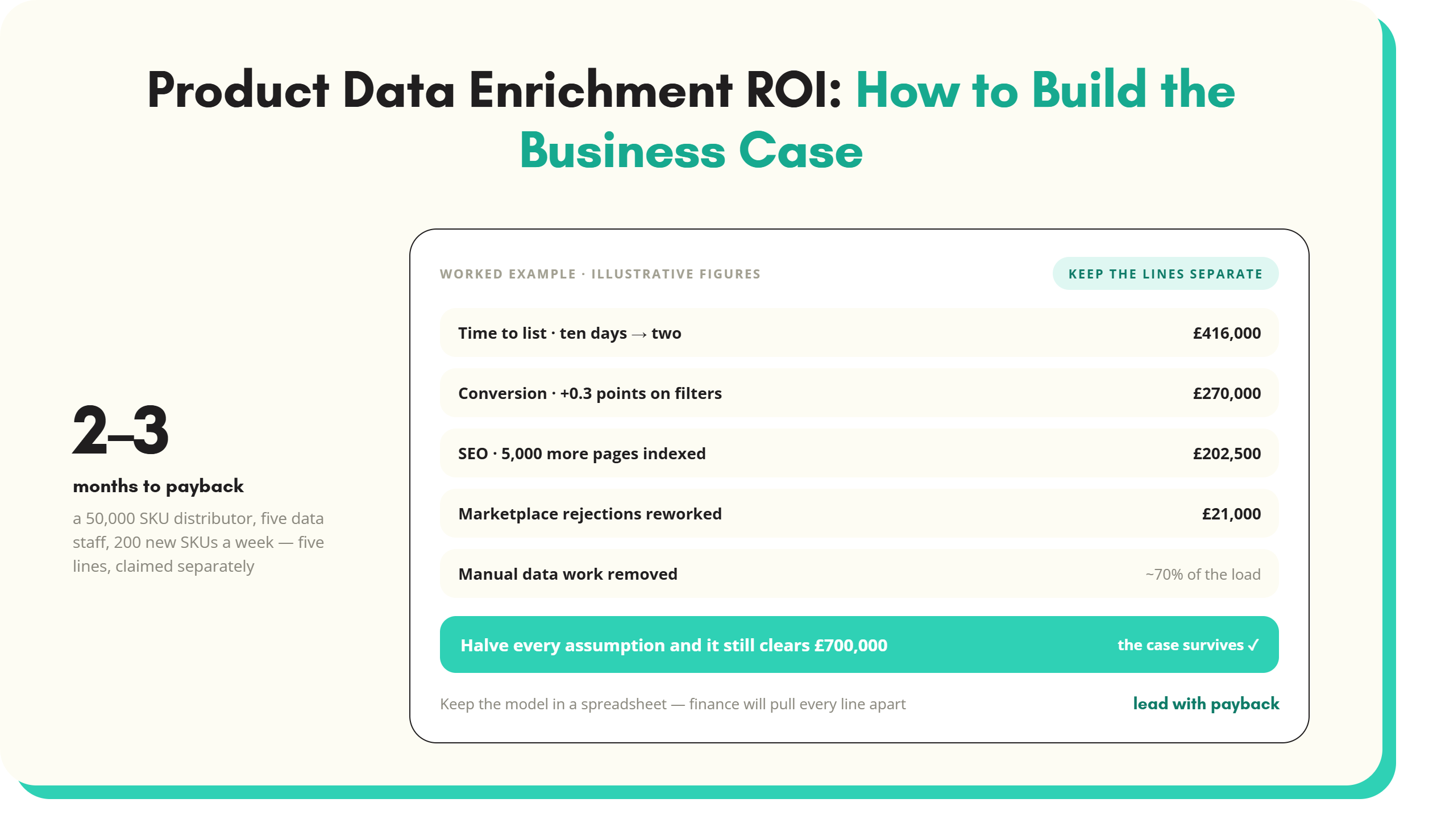
Take a distributor with 50,000 active SKUs, five people in the merchandising and data team, and 200 new SKUs arriving from suppliers every week. Annual website revenue is £40 million, average order value £180, sessions roughly 500,000 a year. The numbers below are illustrative; the point is to show the shape of the calculation.[2]
Manual cost saved
Your people, on £45,000 fully loaded each, with 60 percent of their time spent on data tasks, gives thousands of pounds of effort tied up in cleaning supplier files. Enrichment cuts roughly 70 percent of that load. Saving? Considerable.
Time to list
200 new SKUs a week across 52 weeks is 10,400 SKUs a year. The current queue runs at about ten working days from supplier file to live listing. Enrichment typically pulls that down to two days. At a conservative £5 of revenue per SKU per day once listed, the calculation is 10,400 x £5 x 8 days saved = £416,000.
Conversion uplift
Baseline conversion 2.5 percent. Cleaner attributes and working filters drive a 0.3 percentage point uplift, which sits at the lower end of what most distributors see when filterability improves. 500,000 sessions x 0.003 x £180 = £270,000.
Rejection cost saved
100 rejected marketplace listings per month, 30 minutes of rework per fix, £35 loaded hourly cost. 100 x 12 x 0.5 x £35 = £21,000.
SEO uplift
5,000 additional product pages indexed because they now carry schema-compliant attributes. 50 impressions per page per month, 1.5 percent click-through, 2.5 percent conversion, £180 AOV. 5,000 x 50 x 12 x 0.015 x 0.025 x £180 = £202,500.
Total
About £1 million a year. Run the same numbers at 70 percent confidence o (n every line and you still clear £700,000. If the enrichment platform costs £150,000 a year all-in, including licences, integration work, and internal time, payback is two to three months at full ramp. For pricing benchmarks, see the SKULaunch pricing page.
What product data enrichment ROI looks like in the real world
Three SKULaunch customers have run the numbers and published the results. None of these are ceiling cases. They are the floor: outcomes from teams that turned on the tooling and let it work.
- Mole Valley Farmers enriched 35,000 SKUs in three weeks. The previous manual estimate for the same work was nine months. Cost saving alone, before any revenue effect, was six figures. See the full Mole Valley Farmers case study.
- Bowens, an Australian building materials distributor, took its PIM completeness from 30 percent to 94 percent. The completeness change drove measurable conversion uplift on categories that had previously been unfilterable. See the full Bowens case study.
- PS Industrial reduced enrichment time per SKU from 45 minutes to a few minutes. For a catalogue adding 100+ new SKUs a week, that single shift returned an FTE inside the first quarter.
How to present the business case to finance
A good business case is a single page with the headline number at the top. The framework, the methodology, the formulas, all of that goes in the appendix. Lead with the answer.
- Lead with the headline saving. Slide one is "annual return: £900,000 to £1.1 million, payback in three months". Everything else supports that one number.
- Show payback period, not just annual return. CFOs care more about how many quarters it takes to recover the investment than about the headline annual number. Three months reads differently from eighteen.
- Have the half-rate model ready. The question every finance director asks is "what happens if your conversion uplift is half what you assumed?" If the case still works at 50 percent confidence on every line, you have the argument. If it does not, drop the conversion line and stand on cost savings alone.
- Pre-empt the build-versus-buy question. Finance will smell optionality. Have an answer ready on internal-build cost: typically two to four engineers for nine months, plus permanent maintenance capacity.
- Keep the model in a spreadsheet, not slides. Finance will want to pull every assumption apart line by line. Burying the numbers in a deck is the fastest way to stall the case for another quarter.
Common objections and how to handle them
"We’ll build it internally"
The build cost is rarely the problem; the maintenance cost is. Rules-based extraction systems require continuous tuning as supplier formats change. AI-based extraction systems require model evaluation, prompt management, and infrastructure. Both consume permanent engineering capacity. Most teams that build internally end up with a working system for the suppliers they had at launch and a backlog of broken cases for everything that has arrived since. Buying gets you a maintained system. Building gets you a permanent project.
"Our PIM already does this"
A PIM stores enriched data; it does not produce it. Turning a supplier PDF into structured attributes, classifying the product against the correct taxonomy, generating descriptions and image variants: none of that work happens inside Akeneo, Plytix, or Inriver. PIMs assume the data arrives clean. Enrichment is what makes it clean. For the longer version of this argument, see the cluster article on product data enrichment versus PIM.
"We don’t have a data quality problem"
Test the claim before accepting it. Pick 100 SKUs at random from the live catalogue and score each against the category template for completeness. If the average is above 80 percent, you are in the small minority and can defer the project with a clear conscience. Most teams that run the test come back surprised: average completeness in distributor catalogues sits between 40 and 70 percent, and the gap is invisible until somebody counts.
Key takeaways
- Product data enrichment ROI is calculated across five separate categories: manual cost, time to list, conversion, marketplace rejections, and SEO. Keep them separate.
- A 50,000 SKU distributor with five data staff and 200 new SKUs a week typically clears £700,000 to £1 million a year in returns at conservative assumptions.
- Lead the business case with payback period and headline annual return. Three months reads better to a CFO than eighteen.
- Anticipate the half-rate stress test. If the case works at 50 percent confidence on every line, the case wins.
- Most "we don’t have a data quality problem" objections fail a 100-SKU completeness audit. Run the test before accepting the objection.
Build the case with your own numbers. We can stress-test your model line by line, book a call.
See it in practice: enrich a catalogue without hiring an offshore team, bulk product data enrichment and new product introduction without the new line form chase.
See SKULaunch in action
Watch how we handle AI enrichment, supplier onboarding, and catalogue scale in a live 30-minute demo.


.avif)