

Most product data enrichment projects don’t fail in the way teams expect.
Most product data enrichment projects don’t fail in the way teams expect. They don’t run out of money, miss a deadline by six months, or get killed by an executive sponsor. They reach a milestone, declare success, then quietly degrade until the catalogue looks much like it did before the project started. Anyone running their second or third product data enrichment project will recognise the pattern. The seven failure modes below come from years of consultancy work with retailers and distributors. None of them is technical. All of them are avoidable.
The seven reasons product data enrichment projects fail
The most common failure modes are clustered into three groups. Three concern scoping mistakes, made before any data is touched. Two are workflow mistakes, made during enrichment. Two are governance mistakes, made after the initial push is complete. The pattern matters because the reset path is different in each case.
1. Treating enrichment as a one-off rather than a continuous capability
The most common pattern. A team is assembled, a backlog is cleared, the project is signed off, the team disbands. New SKUs continue to land each week. Six months later, the catalogue looks much like it did before the project started, except the people who knew how to fix it have gone.
A 60,000-SKU industrial distributor runs a nine-month enrichment project. They finish, sign off, redeploy the team. New supplier onboarding has no enrichment step. By month 18 they have 11,000 unenriched SKUs and the work to fix it is identical to the original project. So, they run a second project.
The corrective is to treat enrichment as a tap rather than a bucket. Build a continuous pipeline: supplier feeds in, enriched data out, every week. Resource the role on a permanent basis, not just for the project.
2. No schema or taxonomy defined up front
The team starts extracting attributes before agreeing what attributes matter for which categories. The result is a catalogue with a dozen variants of "diameter" and three of "voltage", and filters that don’t work because the values live in inconsistent fields. A 50,000-line fastener distributor finishes an enrichment push to find "thread pitch", "thread", "pitch" and "thread size" all in use across the same product family. The faceted search team rebuilds the front-end navigation twice within a year because the underlying schema keeps shifting beneath them.
The corrective is to write the attribute schema per category before any extraction work. With a finite, named list of attributes, controlled values where possible, and unit conventions for measurements. This is unglamorous, and slow, yet it’s the single highest-leverage piece of work in the entire project.
3. Assuming the PIM will handle enrichment
A PIM is bought, often with an enrichment project as justification. The team expects the PIM to extract attributes from supplier PDFs and standardise content. PIMs do not do this. They store enriched data, validate it, and syndicate it to channels. The enrichment work happens upstream.
An eCommerce team at a homewares retailer buys Akeneo, expecting it to read 800 supplier specification sheets. Six months in, they have an ideally configured Akeneo installation with 50% completeness and a team of contractors copy-pasting attributes from PDFs into Excel.
The corrective is structural. Pick the right tool for each job. A dedicated product data enrichment platform sits upstream of the PIM, extracting structured attributes from supplier documents and pushing the enriched output into the PIM as the system of record. The PIM still earns its place; it just stops being asked to do work it was never designed for. Teams with no PIM at all have a simpler route: enrichment platforms with a built-in PIM layer, SKULaunch among them, hold the governed record themselves.
4. Underestimating supplier data variability
Pilots tend to use three or four ‘well-behaved’ supplier feeds, often the largest brands. The team gets good results, signs off the approach, and rolls into production. Production has 200 suppliers, half of whom send data in formats nobody planned for.
An automotive parts distributor with 180 suppliers runs a successful pilot on the four biggest, all of whom ship clean structured feeds. In production they hit suppliers shipping scanned faxes, hand-built spreadsheets with merged cells, and PDFs with attribute values buried in image captions. Model accuracy on the long tail comes in 30 percentage points lower than on the pilot suppliers.
The corrective is to sample the long tail in scoping. Pick five suppliers from the bottom 20% of the supplier list, by data quality or feed frequency, and include them in the pilot. The accuracy numbers will be worse. That is the point. Better to know in week three than month nine, when there is still time to design the exception path before scale exposes the gap.
5. No exception workflow for low-confidence data
AI extraction returns confidence scores. High-confidence extractions go straight through. The question that decides the project is what happens to low-confidence ones. The default answer is often nothing, so bad data flows through unchecked.
A 50,000-SKU lighting wholesaler runs an enrichment job. 87% of attributes come back high-confidence, 13% come back low. The team has no triage workflow, so the low-confidence values go live unchanged. Three months later the merchandising team is rebuilding the navigation because thousands of products are mis-categorised, traceable to that 13%.
The corrective is to design the exception workflow before turning extraction on. Set thresholds per attribute type. Route low-confidence items to a queue. Define who reviews and how fast. The aim is not to eliminate human review, but to direct it where it matters.
6. Starting with bestsellers instead of categories
It feels rational to start with the products that drive revenue. The top 1,000 SKUs matter more than the bottom 10,000. So, the team picks the bestsellers and enriches them first.
A multi-category retailer enriches its 500 top-selling products and discovers they span 27 categories. The team builds 27 partial schemas, finishes none of them, and twelve months later is rebuilding everything as 24,000 more SKUs land in the catalogue with the same partial-schema problem at scale.
The corrective is to start with categories, not products. Pick a category. Build the schema, run the extraction, set up the exception workflow, complete the category. Move to the next. The category to pick first is usually the one with the highest SKU count or the worst current data, not the one with the highest revenue. Bestsellers benefit from the work indirectly. Structural progress comes from finishing categories.
7. No ongoing governance after initial enrichment
The project ends. The team disbands or returns to BAU. Three months in, attribute drift starts. New suppliers add fields nobody types. Categories merge or split without anyone updating the schema. By month six, the catalogue is degrading at roughly the rate it was being enriched at the project’s peak.
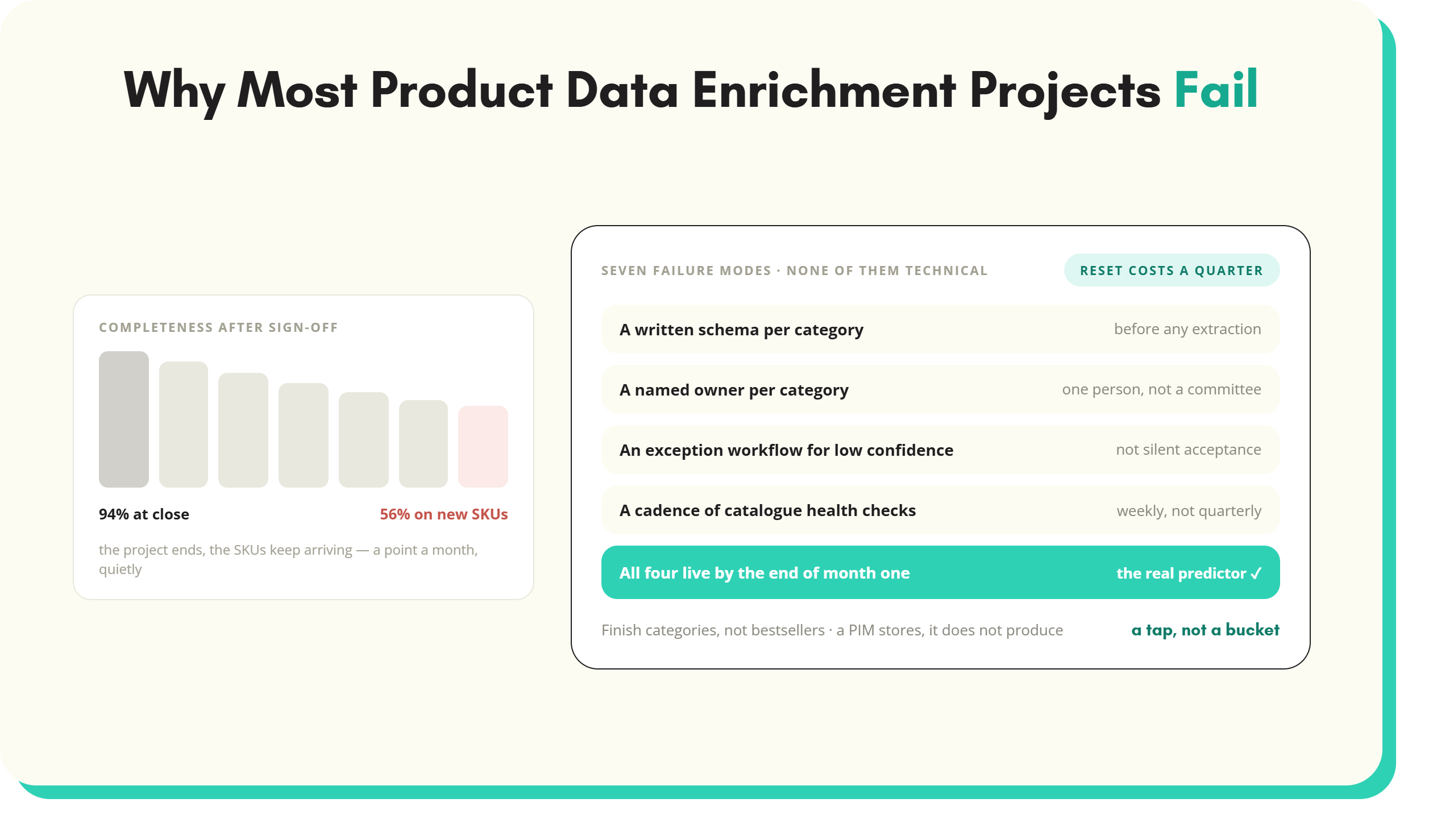
A homewares retailer finishes an eight-month enrichment with 94% completeness across the active catalogue. By month 14, completeness on new SKUs is 56%. The active catalogue is fine, but the new arrivals are pulling the average down by a percentage point a month.
The corrective is a named data owner per category, with a written remit and a monthly health check. Not a committee. Nor a rotating duty. One person, one category, accountable for completeness and consistency. The owner does not do the enrichment; the owner watches the numbers and escalates when they slip.
The single biggest predictor of success in a product data enrichment project
Of the seven failure modes above, six can be partially recovered from. One cannot be retrofitted easily. The single biggest predictor of which projects succeed and which degrade is whether governance is built in from day one, rather than bolted on at the end.
By governance, the working definition is narrow:
- A written attribute schema per category
- A named owner per category
- An exception workflow for low-confidence data
- A defined cadence of catalogue health checks
That is the minimum. Most successful product data enrichment projects ship with all four operational by the end of month one. Most failed projects had none of them in place at any point.
The reason is important. Enrichment isn’t a finite task. There is no final state in which the catalogue is enriched and stays enriched without effort. Every supplier that updates a spec, every new SKU that lands, every category that splits or merges creates new enrichment work. Governance is the structure that absorbs those changes without each one becoming a project of its own.
Teams that treat governance as something to set up after the data is sorted never set it up. The data is never sorted, because the data is continuous. Governance is the first thing to build, not the last.
How to reset a failed product data enrichment project
If you are reading this with a project already in trouble, the reset is rarely "throw away the data and start again". The work usually stands, but the structure around it does not. The reset path:
1. Diagnose which of the seven failure modes apply. It’s almost always more than one, more likely, two or three working together.
2. Stop adding scope. Pause new enrichment until the structural fixes are in place. The instinct is to keep the team busy. Resist that.
3. Rebuild the attribute schema for the two or three categories that matter most by SKU volume. Document it. Get sign-off from merchandising and eCommerce leads.
4. Set up the exception workflow. Define thresholds and name a reviewer. Establish a cadence for reviews so the queue doesn’t stay long.
5. Restart enrichment one category at a time. Finish a category before starting the next. Track completeness weekly, not monthly.
6. Name a data owner per category before the project ends. Write the remit. Schedule the health checks. Close the project against governance criteria, not extraction criteria.
Done well, a reset typically costs less than a quarter of the original project, because the data is mostly there. What’s missing is the structure. Build the structure and the data falls into place. Skip it again, and there is a third project ahead. For teams that want a reference for what ‘good’ looks like, the product data quality page sets out the four elements in more detail.
Key takeaways
- Enrichment is a continuous capability, not a one-off project.
- Schema before extraction, every time.
- A PIM stores enriched data; it does not produce it.
- Sample the long tail of suppliers in scoping, not at go-live.
- Low-confidence data needs an exception workflow, not silent acceptance.
- Finish categories, not bestsellers.
- Governance is built on day one, not bolted on at the end.
Recognise your project in two or three of these failure modes? The reset is usually cheaper than starting over. Book a 30-minute project reset call and we will diagnose which failure modes apply and map the corrective steps.
See SKULaunch in action
Watch how we handle AI enrichment, supplier onboarding, and catalogue scale in a live 30-minute demo.


.avif)