

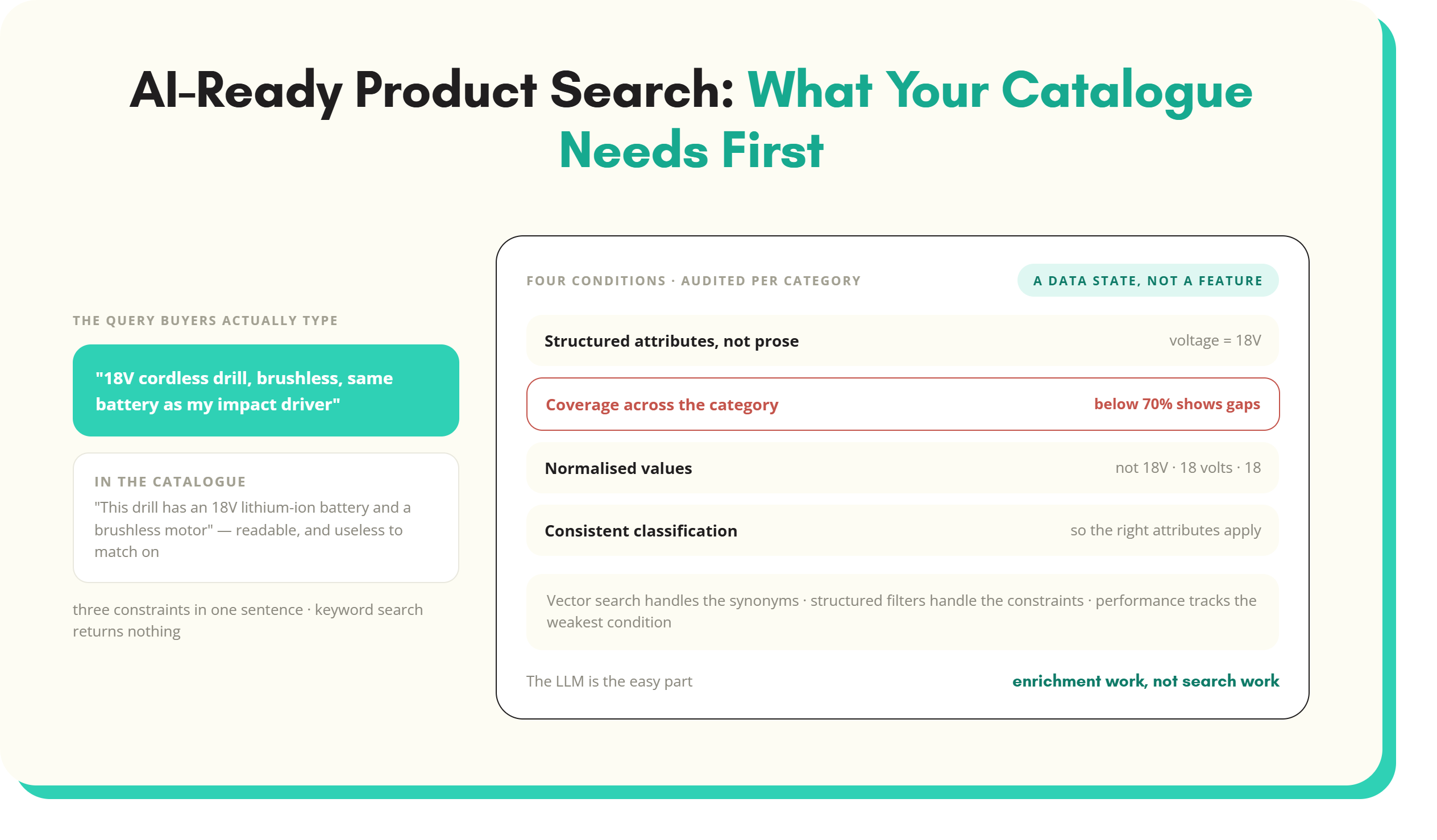
The four conditions LLM and vector search need before they return useful results on a catalogue.
AI-ready product search is the structured attribute foundation that makes large-language-model search and vector search return useful results on a product catalogue. Without it, an LLM asked "what 18V cordless impact driver do you sell with a brushless motor and a quick-change chuck" will hallucinate, return the wrong products, or fail on the simplest filter. AI-ready product search is not a feature you turn on. It is a state your data has to be in.
What "AI-ready" actually means for a product catalogue
AI-ready means a catalogue where every product has the structured attributes that an AI search system needs to match the buyer query against the right SKU. Voltage, dimensions, materials, fitment data, certifications, all captured as discrete fields, all populated, all consistent across the category.
The mistake most retailers make is assuming AI search is about plugging an LLM into the existing site search. The LLM is the easy part. The hard part is the data underneath, and most catalogues are not in the shape AI search needs them to be.
Why traditional search fails on natural-language queries
Traditional product search is built on keyword matching against a description and a title. The query "18V brushless drill" matches because the description contains the words. The query "cordless drill for site work that runs on the same battery as my impact driver" does not match anything, even though the right product exists in the catalogue, because the buyer is asking a structured question in natural language and the catalogue is a free-text index.
AI search closes that gap by reading the query semantically and matching against structured attributes (voltage, battery system, drill type) rather than keywords in prose. But it can only do that when the attributes are there to match against.
The four data conditions AI-ready product search needs
Four conditions have to be true for AI search to work on a product catalogue. Most catalogues meet one or two; getting all four is the work.
1. Attributes are structured, not embedded in prose
"This drill has an 18V lithium-ion battery and a brushless motor" is human-readable but machine-hostile. The same data as voltage = 18V, battery type = lithium-ion, motor type = brushless is what AI search needs. Structured attributes are not just easier to extract; they are easier to compare across products, which is what spec-led queries demand.
2. Attribute coverage is complete across a category
AI search degrades the moment a category has uneven attribute coverage. If half the drills in a category have a torque value and half do not, the LLM cannot rank them on torque. The buyer asking for "high-torque cordless drill" gets a partial answer, which the buyer reads as wrong. Completeness has to be measured and enforced at the category level, not at the SKU level.
3. Attribute values are normalised
Voltage stored as "18V" on one product, "18 volts" on another, and "18" with no unit on a third makes the same field useless for matching. Normalisation, the same value expressed the same way, is what makes the field comparable. This is enrichment work, not search work; the search system inherits whatever the catalogue gives it.
4. Classification maps products to a consistent taxonomy
AI search depends on knowing what category a product is in before it can match queries against the right attribute set. Without consistent classification (an internal taxonomy, ETIM, ECLASS, or Google product taxonomy), the search system has to guess what attributes are relevant, and it guesses wrong on the long tail.
Structured attributes vs unstructured descriptions
A structured attribute is a typed field with a name, a value, and (where applicable) a unit. An unstructured description is the paragraph of prose that talks about the product. Both have a place on a PDP. Only the structured attributes drive AI search.
The split matters because vendors will sometimes claim AI search "reads descriptions". This is technically true and practically misleading. An LLM can extract attributes from prose, but the extraction is lossy, slow, and unreliable, and it has to happen at every query rather than at index time. The pragmatic move is to do the extraction once, upstream, in the enrichment pipeline, and store the structured attributes for the search system to use directly. The SKULaunch piece on extracting product attributes from PDFs covers how that extraction works in practice.
Why vector search is not enough on its own
Vector search (embedding the query and the products in a shared semantic space) is often pitched as the solution to AI-ready search. It helps with synonym matching ("cordless" matches "battery-powered") and with fuzzy semantic relationships, but it does not solve constraints. A query like "18V cordless drill under one hundred pounds with brushless motor" has three constraints (voltage, price, motor type). Vector search will return drills that look semantically similar; it will not filter to the ones meeting all three.
Production AI search uses both: structured attribute filtering for the constraints, vector search for the semantic relevance, and an LLM to read the natural-language query and route the components to the right backend. All three depend on the underlying catalogue data being in the right shape.
How to audit a catalogue for AI-readiness
A practical audit runs four checks per category. Pick a high-traffic category, sample fifty SKUs, and run the checks.
- Attribute coverage: what percentage of the SKUs have all the attributes a buyer would query on. Below seventy percent and AI search will surface gaps.
- Attribute structure: what percentage of those attributes are stored as structured fields rather than buried in description prose.
- Value normalisation: of the structured attributes, how many use a consistent value format (units, casing, controlled vocabularies) across the sample.
- Classification consistency: are all fifty SKUs classified to the same taxonomy node, or are there drifts where similar products are in different categories.
A category that scores well on all four is AI-ready. A category that scores poorly on any one is the category to fix first; AI search will perform on the score of the weakest condition.
What changes once the catalogue is AI-ready
Three things change measurably. Long-tail conversion rises because spec-led queries that previously returned zero results start returning the right product. Answer engine traffic (ChatGPT, Perplexity, Gemini) becomes a meaningful arrival channel because the catalogue is now legible to the LLMs composing answers. The cost of new search features (recommended products, comparison views, smart filters) drops because they all run on the same structured attributes that AI search uses.
The work to get to AI-ready is upstream of the search system. It is enrichment work, classification work, and data quality work. The SKULaunch overview of product data enrichment covers how that pipeline runs end to end.
Key takeaways
- AI-ready product search is a data state, not a feature.
- Four conditions matter: structured attributes, category-level completeness, value normalisation, and consistent classification.
- Vector search and LLM search both depend on these conditions; the algorithm is downstream of the data.
- A catalogue audit by category surfaces which conditions are missing where.
- The work to fix it is enrichment work, not search engineering work.
Where to go next
To go deeper on the enrichment pipeline that produces AI-ready data, see the main SKULaunch overview of product data enrichment. For the structured attribute extraction step specifically, the guide on PDF attribute extraction covers the technical mechanics. For the search-side implications, the faceted search piece is the closest read.
See SKULaunch in action
Watch how we handle AI enrichment, supplier onboarding, and catalogue scale in a live 30-minute demo.

.avif)