

PDP optimisation for retailers and distributors is a different job, and it starts with completeness scoring, not copywriting.
Most PDP optimisation advice is written for B2C fashion retailers. It assumes one product image, one short description, three variants, and a single buyer who scans. That advice falls apart when the product is an 18V brushless drill, the buyer is comparing torque and chuck capacity across four products, and the page needs to be filterable on twelve attributes nobody has captured. PDP optimisation for retailers and distributors is a different job, and it starts with completeness scoring, not copywriting.
Why generic PDP advice fails for spec-led buyers
A spec-led buyer arrives on a PDP with a query that already includes the technical detail. "18V brushless drill under one hundred pounds with quick-change chuck" is one search box, four constraints, and a buyer who will leave the moment any of them is missing. The page has to match the query before it has to convince. Generic PDP advice optimises for the second job and skips the first.
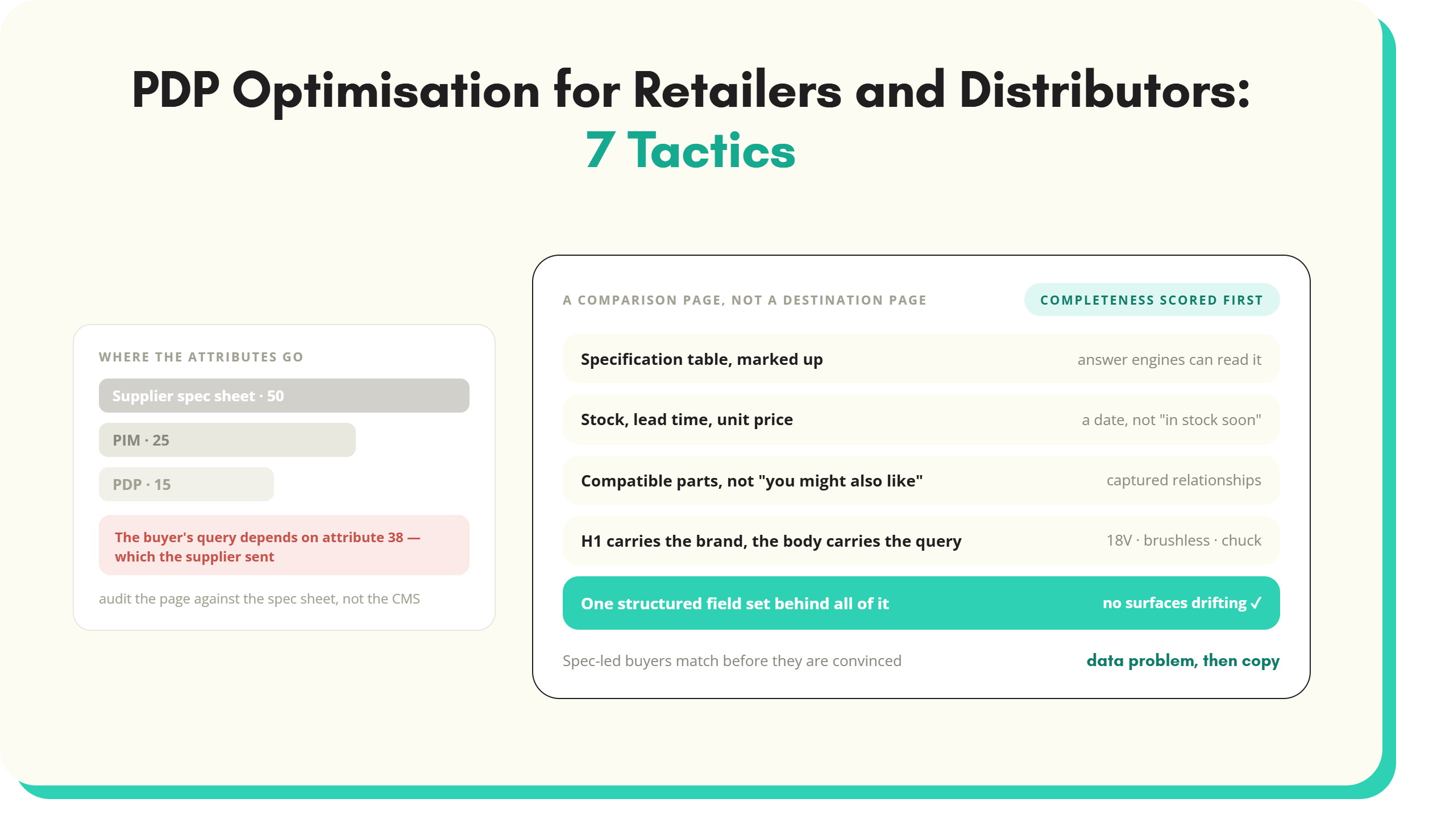
The structural difference is that spec-led PDPs are comparison pages, not destination pages. The buyer is not deciding whether to buy; they are deciding which to buy. The page has to render technical detail at the same level as the buyer is querying. If the supplier sent the data and the page is missing it, the buyer assumes the product does not have the attribute and moves on.
The seven PDP optimisation tactics that move conversion
The tactics below are ordered. The first three set the data foundation; the next four turn the data into a converting page.
Tactic 1: Score completeness before optimising anything
Run a completeness audit before any other optimisation work. For every category, define the attribute set a fully-stocked PDP needs and score every product against it. Bowens went from thirty percent completeness to ninety-four percent over a structured enrichment programme; the conversion lift came from the enrichment, not from a rewrite of the page templates.
Completeness scoring is also where the ROI conversation starts. A category with a forty percent completeness score is leaving forty percent of its faceted-search potential unrealised. Quantifying the gap is more useful than guessing which products to optimise first.
Tactic 2: Treat technical attributes as facets, not as bullet points
A bullet list of features on a PDP is for humans skim-reading. Faceted attributes are for buyers filtering. Both are needed; most distributor PDPs only have the first.
The shift is from "Features: 18V, brushless motor, two-speed gearbox" as free text to a structured attribute set: voltage = 18V, motor type = brushless, gearbox speeds = 2. Once the data is structured, the same fields drive the bullet list, the comparison table, the search facet, and the schema markup. Without the structure, every surface has to be maintained separately and they drift apart.
See the SKULaunch piece on faceted search for distributors for the full breakdown of how attribute structure drives filterability.
Tactic 3: Write for the search query, not the product name
"DeWalt DCD796N 18V XR Brushless Combi Drill Bare Unit" is the manufacturer name. "18V brushless drill" is the search query. The PDP needs to rank for the second while displaying the first, which means the structured attributes have to do the SEO work, not the title.
In practice, this means the H1 carries the manufacturer name and the page body carries the queryable attributes in structured form. Long-tail queries like "18V brushless drill under one hundred pounds with quick-change chuck" only get matched when the page exposes voltage, motor type, price band, and chuck type as separate fields.
Tactic 4: Structure the PDP for AI search and answer engines
Buyers are increasingly arriving from ChatGPT, Perplexity, and Gemini, not from Google search. Answer engines extract structured information from PDPs to compose their answers. A PDP with attributes embedded in prose is harder for an LLM to extract from than a PDP with attributes in structured tables and Schema.org markup.
The practical change is to expose every key attribute in a structured format on the page (a specifications table, ideally also marked up with Product schema) so the LLM can read the data without having to parse free-form description copy. The AI-ready product search piece on SKULaunch covers the audit checks for this.
Tactic 5: Use compatible products, not "you might also like"
"You might also like" is a B2C cross-sell built on viewing patterns. Distributor buyers do not need a recommendation; they need the right accessory, the right spare, the right matching consumable. The cross-sell on a circular saw PDP is the saw blade; the cross-sell on a relay is the mounting socket; the cross-sell on a brake pad is the matching brake disc.
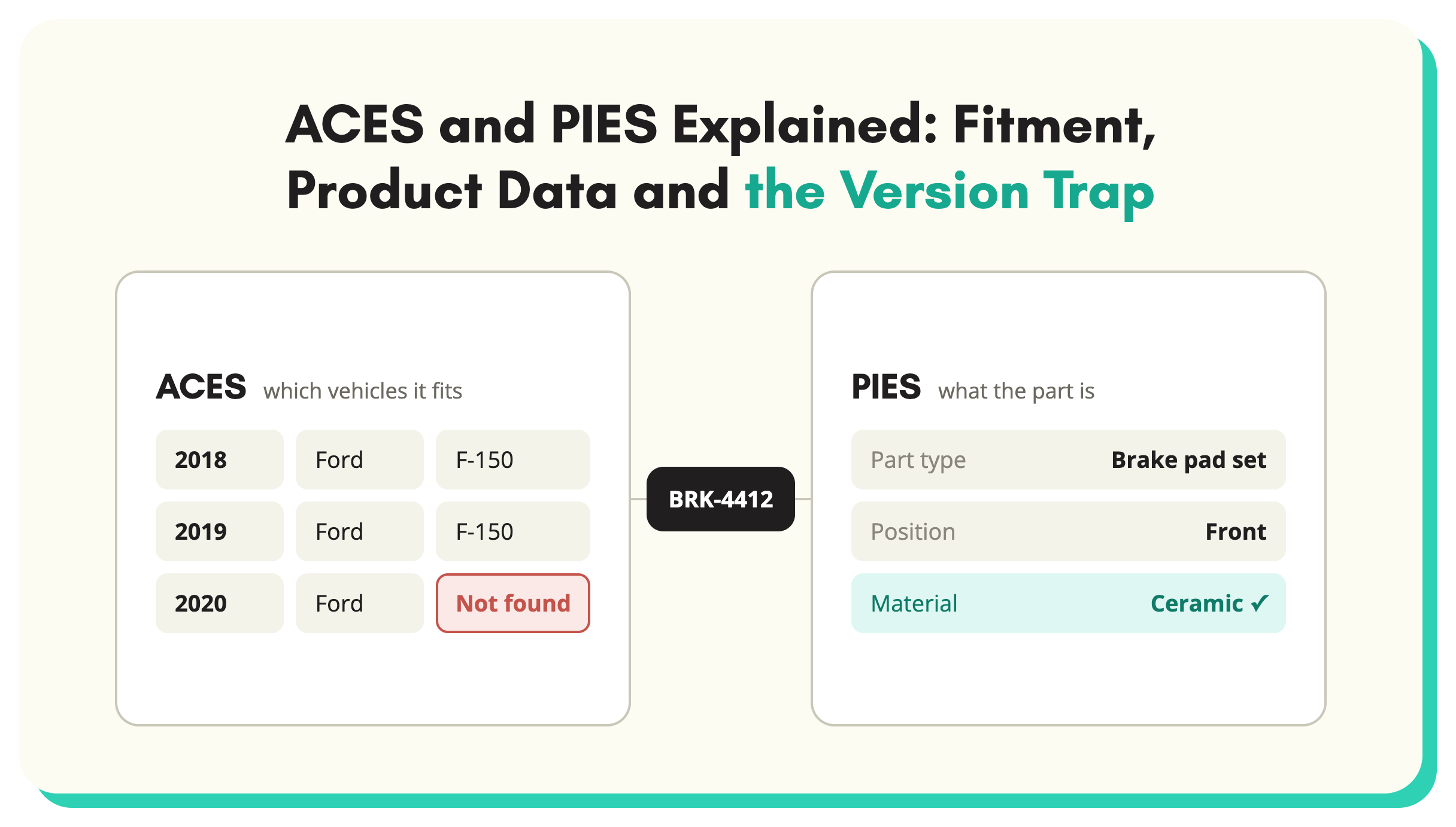
This needs structured product relationships, not algorithmic recommendations. Maxiparts handles this through fitment data: vehicle application codes that link parts to the vehicles they fit. Without that data captured at SKU level, the recommendation engine cannot find the right matches; with it, the cross-sell becomes trustworthy and conversion-positive.
Tactic 6: Show stock, lead time, and unit pricing where the buyer expects them
B2B buyers buy in pack quantities, lead times matter, and a low price with three weeks of lead time often loses to a higher price in stock. The PDP has to surface these the way the buyer assesses them: unit pricing alongside pack pricing, stock at the warehouse the buyer ships from, lead time as a date not a vague "in stock soon".
This is a structured-data problem before it is a UI problem. If the data is not in the system at the right granularity (price per unit, not just per pack), no PDP template can rescue it.
Tactic 7: Audit the PDP against the supplier spec sheet, not the CMS
Most PDP audits look at the page in the CMS and check whether fields are filled. The better audit compares the live PDP against the supplier spec sheet and flags every attribute that the supplier provided but the page does not show.
In practice this catches the long-tail problem: the supplier spec sheet has fifty attributes, the PIM has twenty-five, the PDP shows fifteen. The buyer query that depends on attribute thirty-eight cannot be answered, even though the data exists in the supplier file. The fix is upstream in the enrichment process, where extracted supplier attributes need to flow into the PIM and through to the PDP without falling through the cracks at each transition.
What good looks like end to end
A retailer or distributor with all seven tactics in place looks like this. Every category has a defined attribute set with a target completeness score, and the dashboard tracks completeness by category. Every PDP exposes its key technical attributes in a structured table, marked up with Product schema. The same attribute fields drive the bullet list, the comparison table, the search facet, and the answer-engine extraction. Cross-sells are based on captured product relationships, not algorithmic suggestions. Stock and lead time are accurate and granular. The supplier spec sheet and the live PDP are kept in alignment by an enrichment pipeline that flows changes through to the page.
The conversion lift comes from this end-to-end alignment, not from any single PDP template change. Mole Valley Farmers worked through this pattern across thirty-five thousand SKUs in three weeks; the case study covers the operational mechanics.
Key takeaways
- PDP optimisation for spec-led buyers is a data problem before it is a copy problem.
- Score completeness before optimising; the ROI conversation starts from a measured gap.
- Treat technical attributes as faceted fields, not as bullet points; structure once, surface everywhere.
- Write for the search query (which carries the technical detail), not the product name (which carries the brand).
- Structure the PDP so answer engines can extract from it; LLM-driven traffic is now a measurable share of arrivals.
- Cross-sells need structured relationships, not viewing-pattern algorithms, in B2B and spec-led B2C.
- The most under-rated audit is comparing the live PDP against the supplier spec sheet directly.
Where to go next
For the wider context on managing product data at distributor scale, see the SKULaunch overview of product data management for distributors. For how attribute structure powers filterable search, the faceted search guide covers the practical mechanics. For the data quality dashboards that drive completeness scoring, the platform overview shows what the day-to-day workflow looks like.
See SKULaunch in action
Watch how we handle AI enrichment, supplier onboarding, and catalogue scale in a live 30-minute demo.


.avif)