

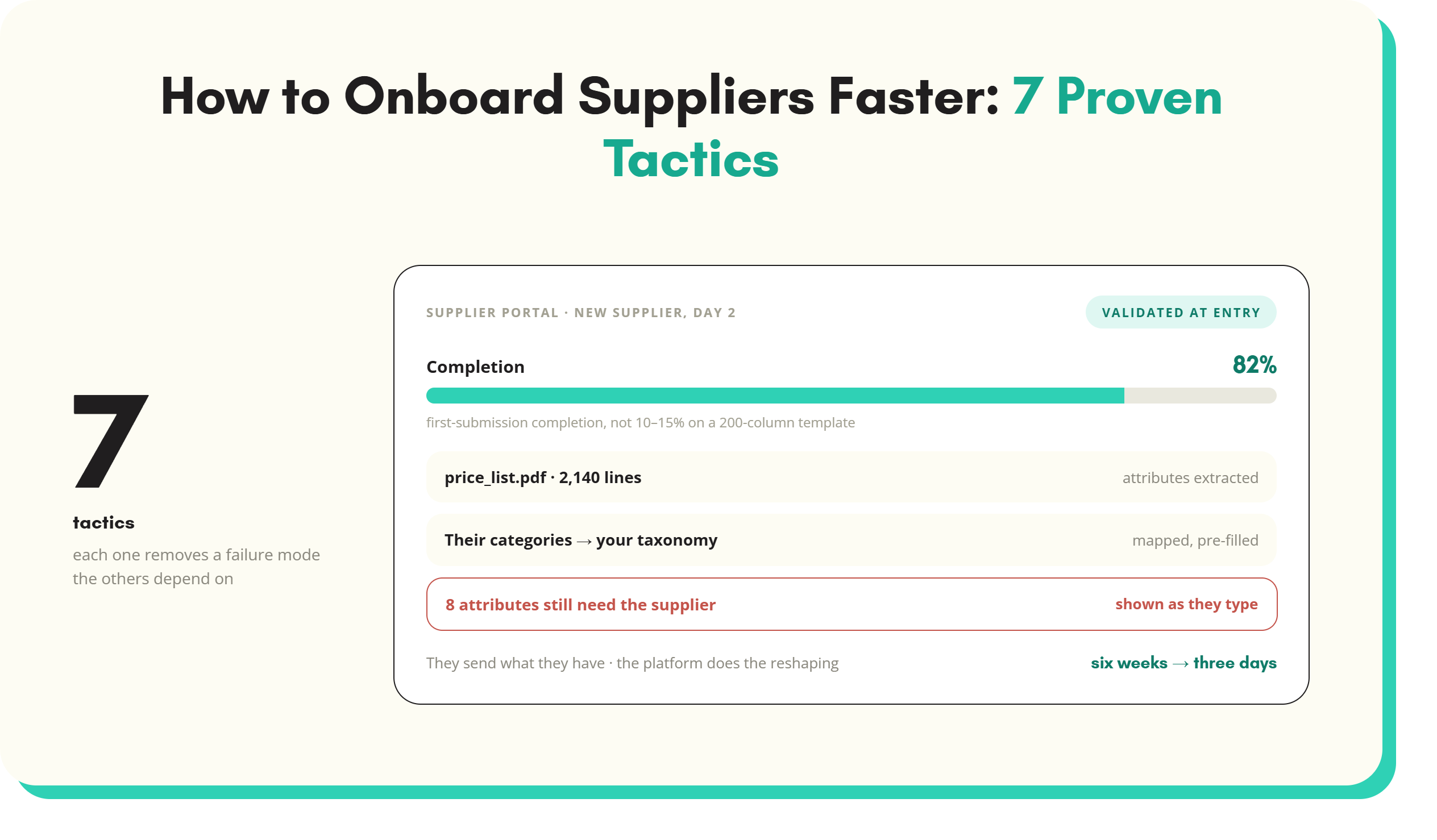
Most teams running a supplier onboarding process know it is slow, but very few have stopped to count how slow.
Most teams running a supplier onboarding process know it is slow, but very few have stopped to count how slow. A 50,000 SKU distributor with 200 active suppliers will often spend six to eight weeks getting a single new supplier from first contact to a published catalogue. To onboard suppliers faster, you have to fix the bottlenecks you have stopped noticing: the master spreadsheet, the email chains, the late-stage import failures.
The seven tactics below have moved the needle for distributors and retailers who rebuilt the process to run in days rather than weeks.
Why supplier onboarding is slow
Before the tactics, the root causes. The same four problems show up in almost every supplier onboarding programme, regardless of vertical or platform. Fixing them in any order helps. Fixing them together is what produces the step change.
The 200-column spreadsheet problem
The master spreadsheet starts as a sensible idea. Every attribute the business wants captured, in one tab, sent to every supplier. Within two product launches it has grown to 200 columns. New attributes get appended on the right. Old ones are kept "just in case". By the time it lands in a supplier’s inbox it is unreadable, even to the people who designed it. Suppliers fill in the first 30 columns, miss the rest, and the merch team spends weeks chasing the gaps. Completion rates on this kind of template typically sit around 10 to 15%.
Format mismatch between supplier and retailer
Your template assumes one row per SKU. Their export does one row per product family with variants in nested columns. Your template expects dimensions in millimetres. Their system speaks inches. You ask for ETIM class codes. They have UNSPSC. Every supplier export needs reshaping before it can be loaded, and the reshaping work falls on whoever is least busy that week. The cost of this mismatch is invisible until you add it up across 200 suppliers.
Back-and-forth email cycles
Most onboarding still runs through email. A supplier sends a file. The data team flags 40 issues. The supplier responds two weeks later with a revised file that fixes 20 of them and introduces eight new ones. Three cycles in, nobody is sure which version is current. Slack threads about specific products start spawning, and the original file path is lost. The supplier disengages because the process feels like it has no end.
No validation until import fails
The break-point is usually the same. The supplier file looks complete. It gets loaded into the PIM. The import fails on row 4,217 because a required attribute is null, or a category code does not match the taxonomy. By the time anyone notices, the supplier has moved on to other work. Days pass before the file gets fixed and reloaded. The cycle starts again. Validation that happens only at import is the single biggest source of cycle-time waste in supplier onboarding.
Seven tactics to onboard suppliers faster
These tactics are independent. You can adopt any one of them and see improvement. You will see the step change when they run together, because each one removes a failure mode that the others depend on.
1. Replace the master spreadsheet with a portal
A spreadsheet sent by email cannot tell the supplier what is missing, cannot validate as they type, and cannot show their progress. A supplier portal can do all three. The right portal lets suppliers upload files, paste URLs, drag in PDFs, or fill in attributes directly, all against the same destination schema in the background. SKULaunch’s supplier portal is built around this pattern. The win is not the portal itself, it is what the portal lets you stop doing, namely chasing spreadsheets.
2. Accept supplier data in whatever format they send it
The instinct when onboarding stalls is to tighten the template. The faster move is the opposite. Let suppliers send data in their own format, then transform it on your side. A modern enrichment layer can ingest spreadsheets with different column orders, PDFs with embedded specifications, CSVs with row-per-variant or row-per-family structures, even images of product labels and packaging. The transformation runs once against your schema, not 200 times against 200 supplier formats. The supplier sends what they have, which is the only file they will ever send on time.
3. Validate at entry, not at import
Validation at the point of submission is what cuts onboarding from weeks to days. As a supplier completes a record, attributes are checked against type, range, mandatory status, and lookup values. Errors surface immediately, with a clear reason. The supplier fixes them while the context is fresh, not three weeks later after a failed import. Treat validation as a user-experience feature, not a back-office gate. The supplier never sees an "import failed" email because the import never fails.
4. Pre-fill what you already know
For an existing supplier, you already have most of their data. For a new one, you can often infer brand, manufacturer codes, basic taxonomy mappings, and standard pack sizes from their first submission. Pre-fill these for them. The less typing a supplier has to do, the less reason they have to abandon halfway. Asking someone to type their company name and product category for the fourth time is a good way to lose them at the first hurdle.
5. Show suppliers their completion status
Suppliers will not act on a request they cannot see. A progress indicator showing 60% complete, with a list of the remaining attributes and which products they belong to, is a stronger nudge than a chasing email. Make the missing-attributes view shareable, so the supplier’s product manager can hand off to their technical team without re-explaining the brief. The fewer people in the chain who have to remember context, the faster the file moves.
6. Run AI enrichment on supplier submissions
The biggest improvement most teams see is not making suppliers do more, it is doing less of the work on the supplier side at all. AI extraction can read a supplier PDF and produce structured attributes against your schema. AI classification can map their categories to yours. AI content generation can produce a first-pass product description from a spec sheet. The supplier sends what they have. You enrich it. The conversation about "missing attributes" becomes a conversation about "verify these extracted attributes", which is much faster and much less adversarial.
7. Measure onboarding time and hold it down
Most teams cannot tell you how long it takes a new supplier to go from first contact to live in the catalogue. If you cannot measure it, you cannot improve it. Track cycle time per supplier, completion rate at first submission, validation pass rate, and the average number of clarification cycles per supplier. Review the numbers monthly. The metrics expose where the work is actually getting stuck, which is usually not where people think. Bowens in Australia moved completeness from 30% to 94% by running this kind of measurement alongside the tooling change, captured in their case study.
What a modern supplier onboarding workflow looks like
End to end, with the seven tactics applied, the workflow stops resembling the spreadsheet-and-email loop. A new supplier receives an invite to a portal rather than a 200-column file. They upload whatever they have: an export from their PIM, a price list PDF, a folder of spec sheets, a URL to their public catalogue. AI extraction pulls structured attributes from the documents and maps them to your schema. The supplier sees a completion view that shows what is verified, what is inferred, and what is missing. They confirm or correct the AI’s output, fill in the genuine gaps, and submit. Validation runs as they go.
Approval becomes a review of clean, validated data rather than a triage of import errors. A supplier that used to take six weeks now moves through in three to five days. For a full breakdown of how the stages fit together, see the supplier onboarding workflow guide.
Expected outcomes when you onboard suppliers faster
The numbers are concrete when the tactics land together. First-submission completion rates move from the 10 to 15% typical of master spreadsheets to 80% or higher in well-designed portals. Cycle time moves from weeks to days, sometimes to hours for established suppliers with clean source data. Supplier churn drops, because the onboarding process is no longer the reason they walk away from a relationship that was otherwise viable.
Internally, the merch and data teams stop being a clearing house for incomplete files and start doing the merchandising work they were hired for. None of this requires asking suppliers to work harder. It requires asking them to do less and pushing the work onto software that can handle it.
For a wider view of how these tactics fit into a complete operating model, see the supplier onboarding software pillar, or the supplier data onboarding solution overview. The platform-level toolkit is described under supplier onboarding software in more depth.
Talk to SKULaunch
Tearing your hair out with a kaleidoscope of supplier formats? Book a discovery call today with SKULaunch. We will walk through your current onboarding process, show how AI extraction reads PDFs, spreadsheets, images, and URLs against your schema, and give you a concrete plan to cut your supplier cycle time from weeks to days. No slides, no generic demo, just your data and your suppliers.
See it in practice: onboard a new supplier range in days, not months, let suppliers upload images and documents with permanent links and request product data updates from suppliers.
See SKULaunch in action
Watch how we handle AI enrichment, supplier onboarding, and catalogue scale in a live 30-minute demo.



.avif)